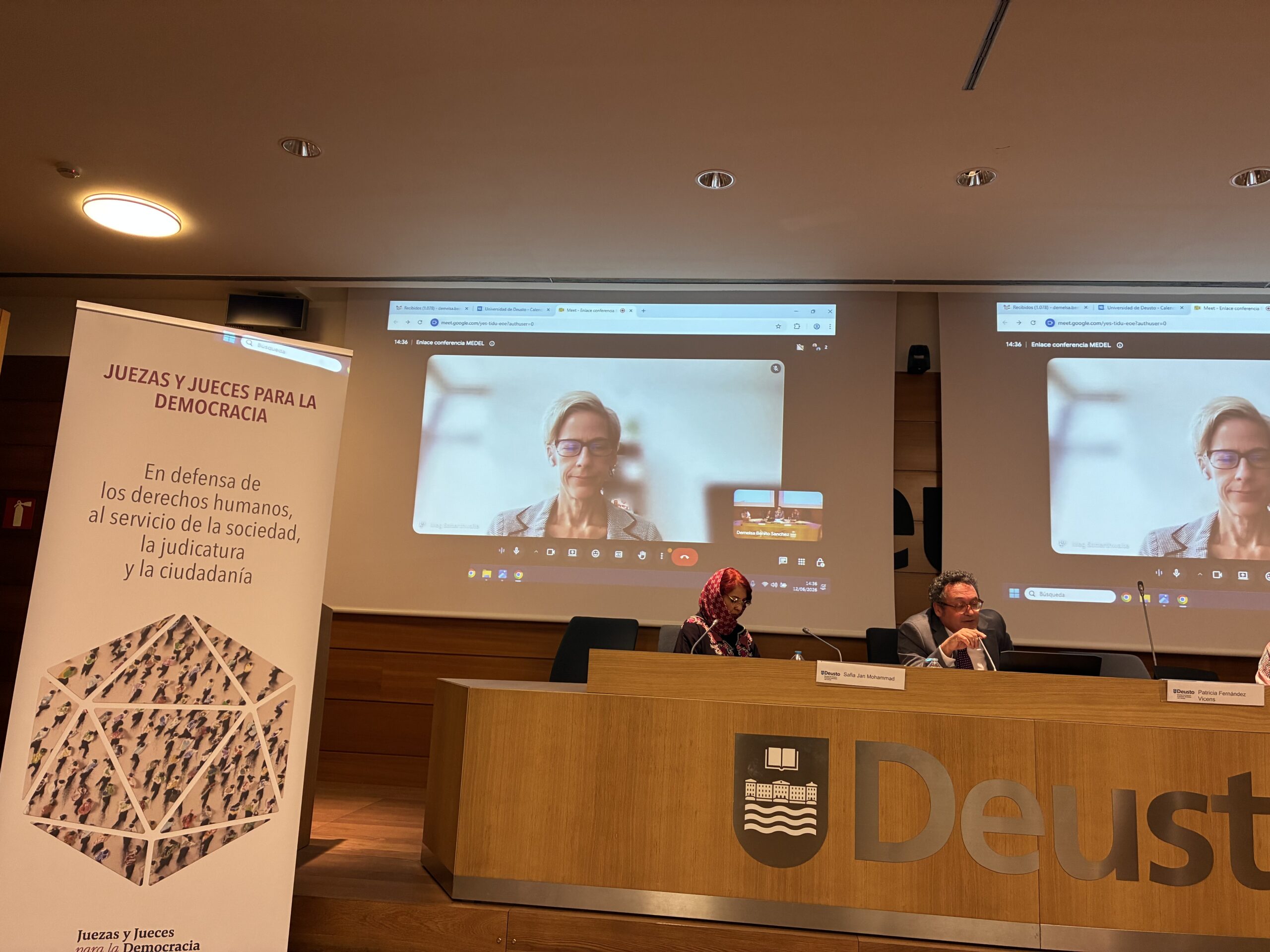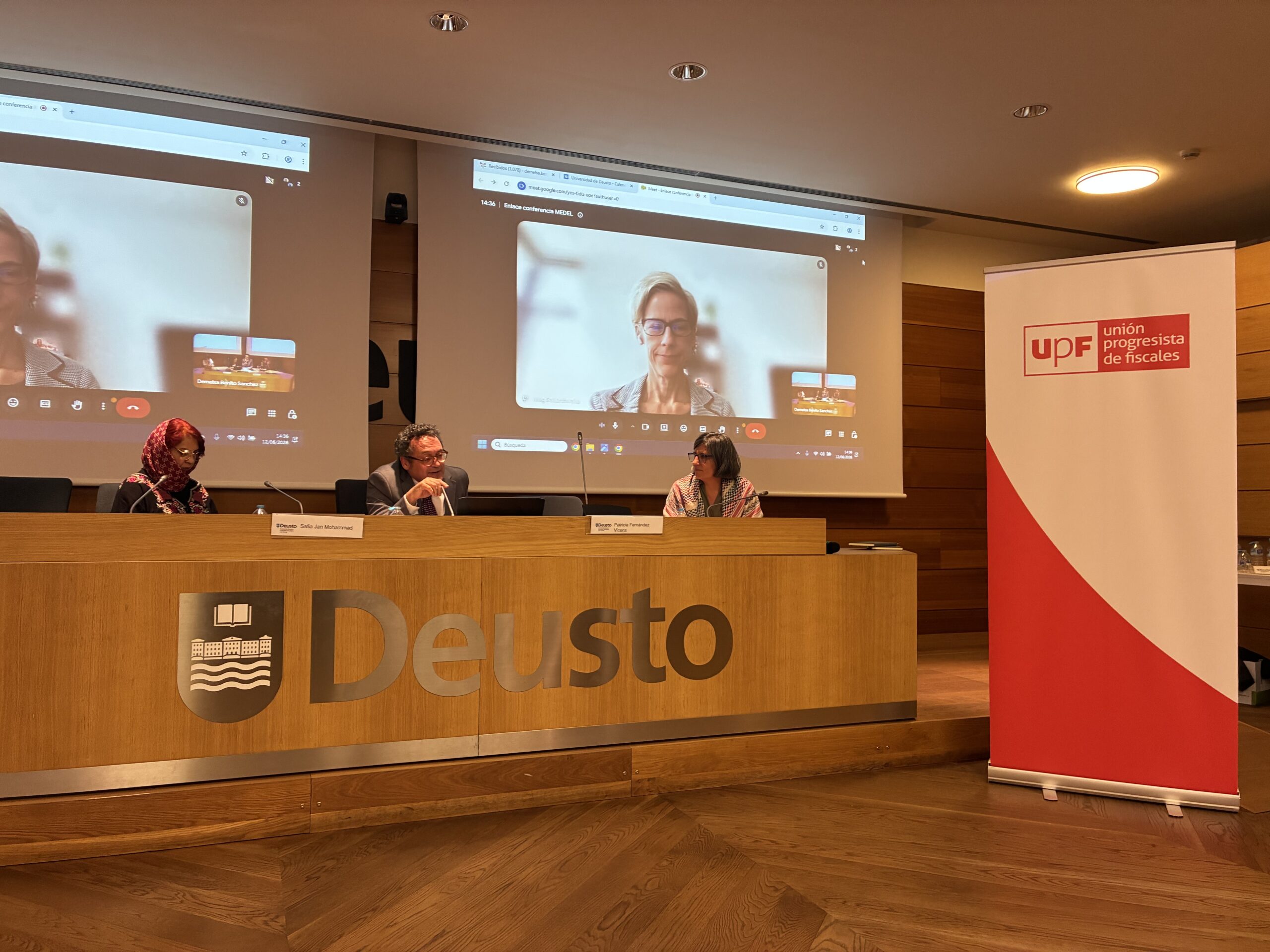

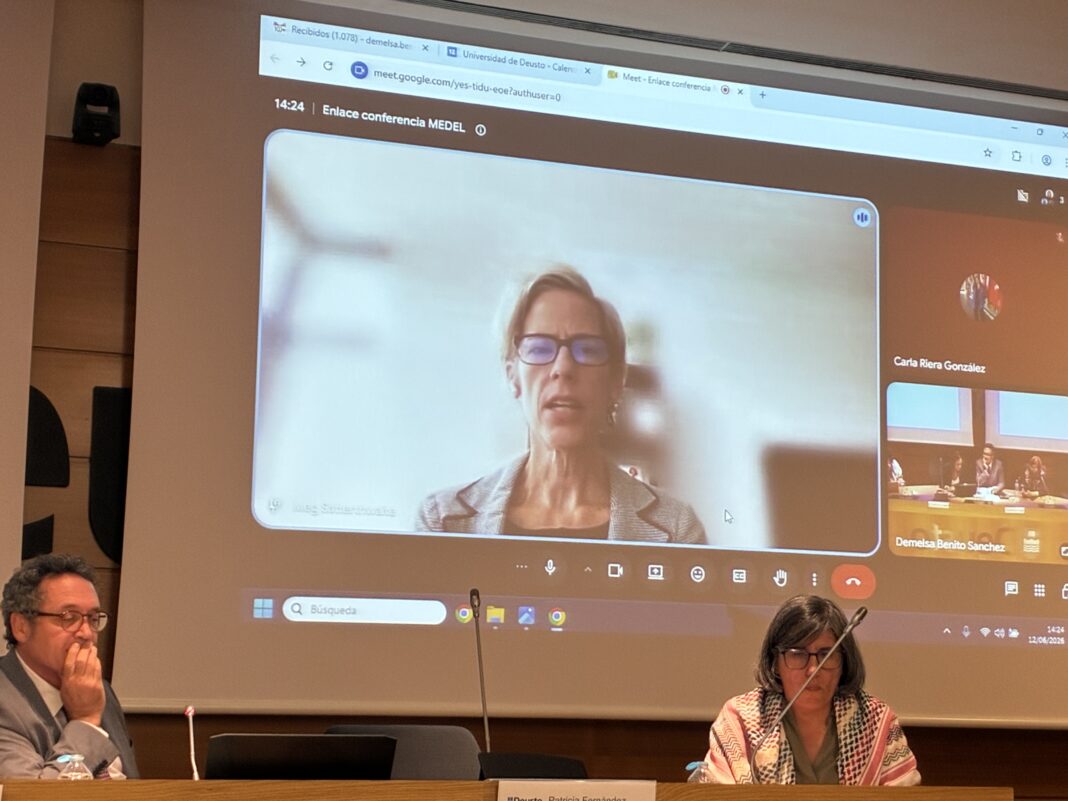

The speech by the UN Special Rapporteur on the Independence of Judges and Lawyers, Prof. Margaret Satterthwaite, at the MEDEL International Conference “Double Border: Gender and Childhood in Modern Migrations. European Regulations and Human Rights”( Bilbao- June 12,2026).
Distinguished participants,
It is a pleasure to join you today to discuss the intersections between migration, gender and childhood from the perspective of my mandate as Special Rapporteur on the independence of judges and lawyers. I am particularly grateful for the opportunity to participate, even if only virtually, and I hope to visit Spain soon.
The three panels that frame today’s discussion raise important questions regarding asylum, international protection and the safety and dignity of migrant women and children. Yet underlying all of these issues lies a fundamental concern that is often overlooked: access to justice.
- As I have emphasized throughout my mandate, rights only become meaningful when individuals are able to claim them before independent institutions capable of providing effective remedies.
- For migrants, refugees, asylum seekers and displaced persons, access to justice is not an abstract aspiration; it is often the determining factor between protection and vulnerability, inclusion and exclusion, dignity and marginalization.
- This is particularly true for women and children, who frequently experience multiple and intersecting forms of discrimination throughout migration processes.
Today, we observe with deep concern how effective judicial protection and the independence of courts increasingly constitute the last line of defence for these vulnerable groups.
- When administrative systems fail, when political narratives become hostile and rights become contested, courts and legal professionals often remain the final institutional actors capable of ensuring that rights are not simply removed through political expediency.
Allow me to turn first to children.
- Children affected by migration are not merely beneficiaries of protection; they are rights holders, and this principle must guide every administrative and judicial procedure affecting their lives.
- Child-friendly justice is therefore not simply good practice but a legal obligation arising from international human rights law, particularly the Convention on the Rights of the Child.
- Children have the right to be heard (Article 12), the right to receive information in a manner they can understand (Article 13), the right to legal assistance (Article 37), and the right to have their best interests assessed through procedures (Article 40) that genuinely take account of their views (Article 12).
Recent developments in European human rights jurisprudence have reinforced these principles. In M.P. and Others v. Greece, the European Court of Human Rights recognized the right of children to be heard in proceedings affecting them.
- Importantly, the Court recognized that children’s participation is not merely aspirational but a procedural guarantee inherent in the protection of family life under Article 8 of the European Convention on Human Rights.
- This judgment represents an important step forward for child-friendly justice because it reinforces the understanding that the best interests of the child cannot be properly determined without considering the child’s own voice.
- For migrant and refugee children, whose futures depend on decisions concerning asylum, family reunification, detention or return, this principle is particularly significant.
The rights of children also require us to confront a related issue: the expansion of immigration detention, which has been underlined as a worry regarding the new EU return policy.
- International human rights mechanisms, including the UN Working Group on Arbitrary Detention, have repeatedly emphasized that detention should never become the default response to migration, in coherence with Article 37 of the Convention of the Rights of the Child.
- Any deprivation of liberty must be exceptional, necessary, proportionate and based on an individualized assessment.
- Yet in many jurisdictions we continue to observe systems in which particularly in migration contexts.
- For children, the consequences are especially severe.
- According to UNICEF, deprivation of liberty can have profound developmental, psychological and social effects and is not compatible with the child’s best interests.
- If we are serious about protecting children’s rights, migration governance must move away from detention-centred approaches and toward protection-centred systems that place the dignity and rights of the child at their core.
These concerns must be understood within a broader global context.
- In my report to the Human Rights Council on safeguarding the independence of judicial systems in the face of contemporary challenges to democracy, I warned that attacks on judicial institutions rarely occur in isolation.
- Rather, they form part of broader processes that weaken checks and balances, diminish accountability and undermine the rule of law.
- We are witnessing democratic decline in many parts of the world, and migration increasingly serves as one of the principal arenas through which these dynamics unfold.
- Across different regions, including both Europe and North America, political actors have increasingly portrayed courts as obstacles to migration control and judges as actors who allegedly grant “too many rights” to migrants and asylum seekers.
- This dynamic has resulted in the attacks suffered by the European Court of Human Rights.
- Courts become targets precisely because they insist that human rights obligations continue to apply even in politically sensitive circumstances.
Migration policies have therefore become a testing ground for restrictions on rights and guarantees.
- We observe a growing tendency to prioritize deterrence, containment and externalization measures while procedural safeguards, access to remedies and individualized protection receive comparatively less attention.
- Yet sustainable migration governance cannot be built solely on border management. It must also be built on inclusion, rights protection and access to justice.
- A system that focuses exclusively on preventing arrival while neglecting effective protection mechanisms risks undermining the very values upon which democratic societies are founded.
When political institutions fail to protect rights, courts frequently become the last guarantors of legality.
- And when courts become the last guarantors of legality, judges themselves often become targets.
- This reality is reflected not only in attacks against institutions but also in attacks against individual justice operators.
- During my recent country visit to Guatemala, I documented how judges, prosecutors and other justice operators investigating corruption and serious human rights violations have faced intimidation, harassment, criminalization and, in many cases, forced exile.
- This displacement represents far more than an individual tragedy.
- The forced exile of justice operators deprives societies of highly qualified professionals, weakens institutional capacity, reduces leadership and visibility in accountability processes, and often results in the abandonment or dismissal of cases involving serious human rights violations.
The consequences are also deeply gendered.
- Women judges and prosecutors frequently remain primary caregivers within their families.
- Their forced displacement therefore affects not only their professional lives but family structures as a whole, generating disproportionate burdens for women and compounding the harms associated with exile.
- As we discuss migration and displacement today, it is therefore important to remember those judges, prosecutors and lawyers who themselves become forcibly displaced because they seek to uphold the rule of law.
- I am particularly mindful of colleagues from Afghanistan and other contexts represented here today, whose experiences remind us that defending justice can itself become a cause of persecution and displacement.
This brings me to a related issue that sits at the intersection of migration governance and judicial independence: immigration adjudication.
- Foreign nationals are entitled to numerous protections: the right to due process; the prohibition of arbitrary expulsion; the rule against arbitrary detention and removal; and the prohibition of refoulement to a risk of torture, arbitrary deprivation of life, persecution, or other grave human rights violations.
- These rights are established in customary international law and enshrined in articles 2, 6, 7, 9, 13, and 14 of the International Covenant on Civil and Political Rights (ICCPR), as well as article 3 of the Convention Against Torture (CAT), and article 33 of the Refugee Convention through the 1967 Protocol Relating to the Status of Refugees in November 1968.
Under international human rights law, decisions concerning expulsion, deportation and non-refoulement engage rights of the highest importance because they may expose individuals to irreparable harm.
- For this reason, the Human Rights Committee has stated that “[a]dministrative mechanisms,” empowered with the capacity to investigate human rights violations, must do so “through independent and impartial bodies.” This includes administrative or judicial bodies that interrogate, examine and determine issues related to migrant deportations.
Thus, under international law, the guarantees of independence remain essential.
- Individuals appearing before immigration adjudicators may face detention, removal, family separation or return to persecution.
- States should therefore ensure that immigration adjudicators benefit, mutatis mutandis, from safeguards concerning appointment, tenure, promotion, discipline and removal. They must be able to perform their functions without intimidation, harassment, political interference or arbitrary dismissal.
- The temporary or provisional appointment of migration adjudicators are particularly concerning in this context.
- Individuals deciding matters of detention, deportation or protection should not remain dependent upon discretionary renewal or termination by the executive branch.
- If immigration adjudicators are expected to safeguard fundamental rights, they must possess the independence necessary to do so.
These concerns connect directly to the focus of my most recent report to the Human Rights Council on principles for judicial appointments.
- The report begins from a simple premise: judicial independence starts long before a judge hears a case.
- It begins with the way judges are selected and appointed.
- Poorly designed appointment processes leave judicial systems vulnerable to politicization and capture.
- When considerations such as political loyalty, ideological alignment or connections to powerful interests penetrate selection mechanisms, they can shape who enters the judiciary and, ultimately, the capacity of courts to protect rights.
- Conversely, appointment systems grounded in merit, integrity, ability, transparency and diversity strengthen public confidence in the administration of justice and help safeguard judicial independence.
- The report therefore emphasizes the importance of objective and pre-established criteria, independent and impartial selection mechanisms, strict limits on provisional appointments, transparency, equality of access, diversity and representativeness, and safeguards against political interference in judicial careers.
- These principles are not abstract institutional concerns; they are practical guarantees designed to ensure that courts remain capable of protecting rights when those rights come under pressure.
Ultimately, these issues are deeply interconnected.
- For migrant women seeking protection from violence, for refugee children facing decisions that may determine their future, for asylum seekers challenging detention, for communities seeking accountability for serious human rights violations, and even for judges and lawyers who themselves become targets of persecution, effective judicial protection and the independence of courts constitute the final barrier between rights guaranteed on paper and rights enjoyed in practice.
- When that final barrier is weakened, it is invariably the most vulnerable who suffer first.
- When the barrier is protected, courts can continue to fulfil their essential function: ensuring that human dignity, equality before the law and access to justice remain realities for all persons, irrespective of nationality, ethnicity, migration status, class, gender or age.
Thank you very much.
Margaret Satterthwaite, Special Rapporteur on the independence of judges and lawyers – United Nations Special Procedures
Professor of Law; Faculty Director, Center for Human Rights and Global Justice; Director, Global Justice Clinic; Faculty Director, Robert and Helen Bernstein Institute for Human Rights.
Speech by Margaret Satterthwaite (.pdf)