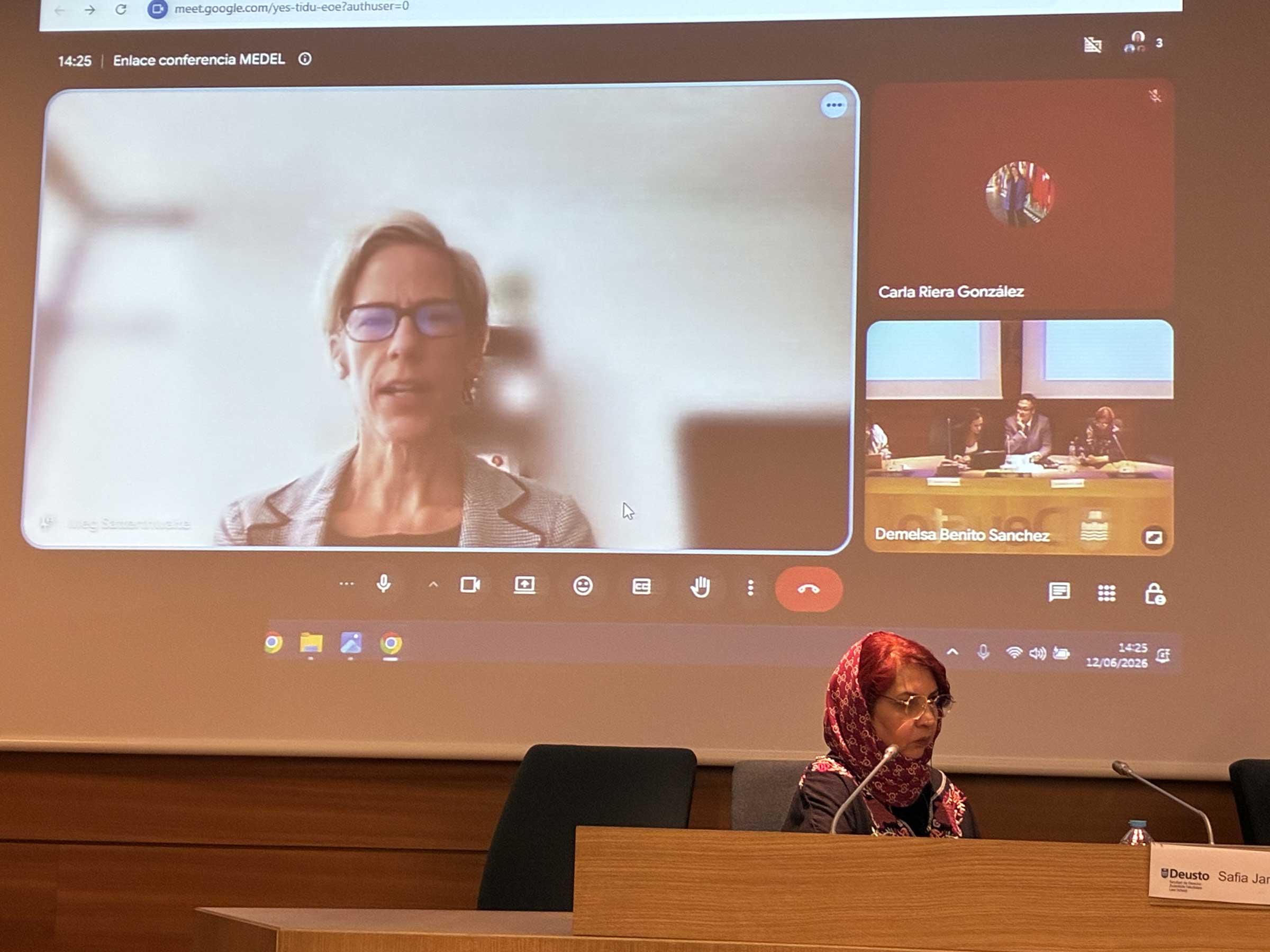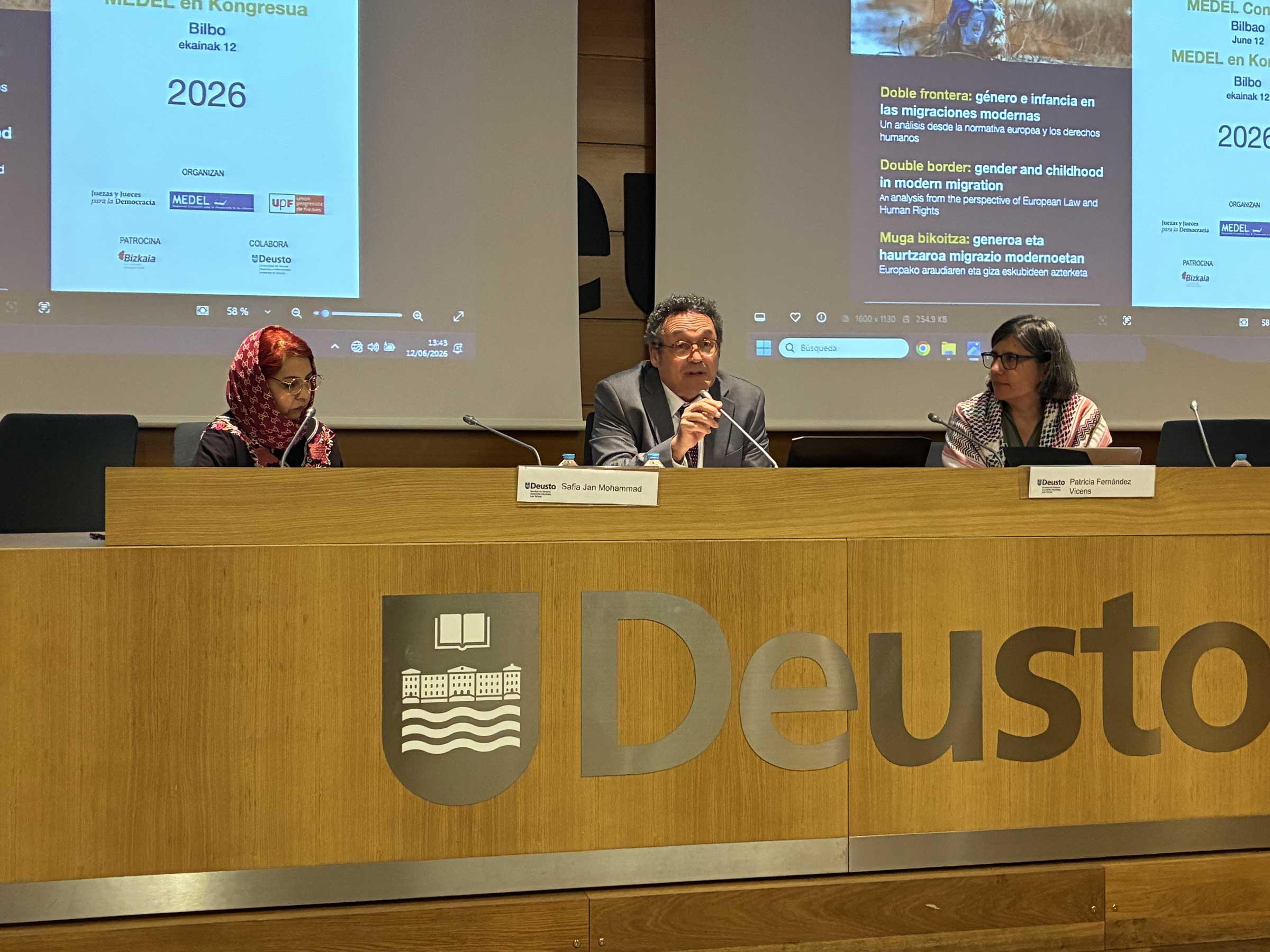

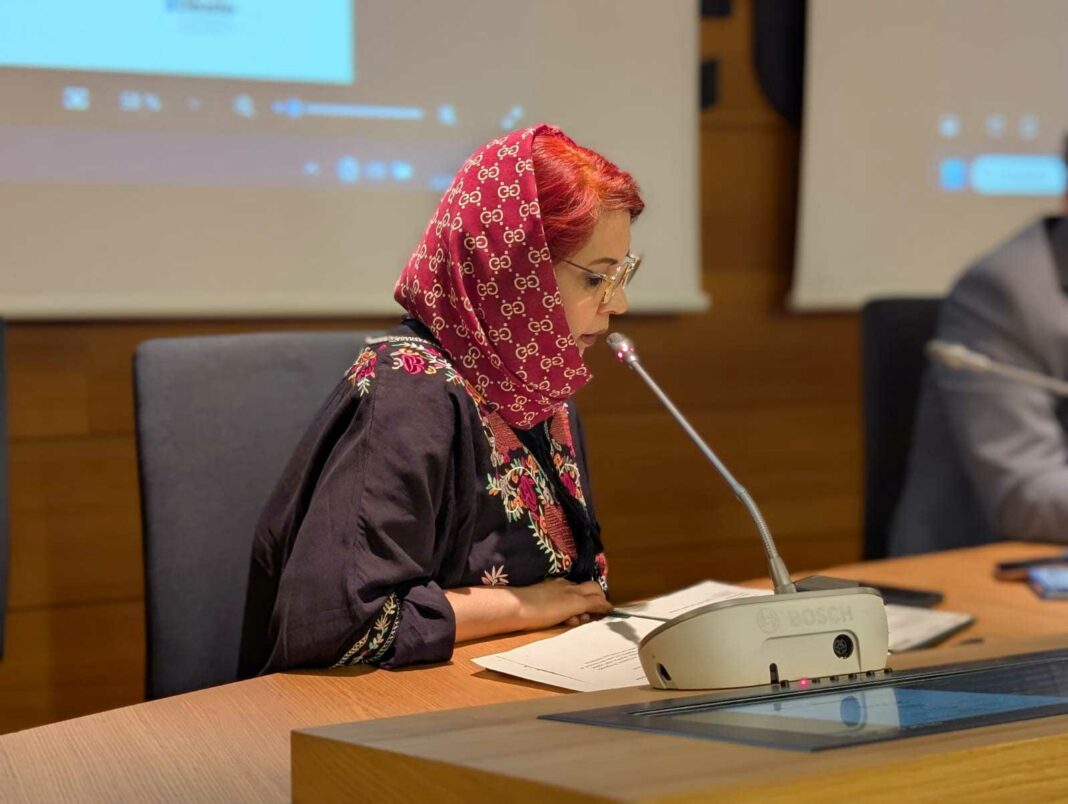

The speech by Safia Jan Mohammad, Afghan judge in exile, at the MEDEL international conference “Double Border: Gender and Childhood in Modern Migrations. European Regulations and Human Rights”, Bilbao, June 12.2026.
“Distance does not erase commitment”: the voice of an Afghan judge
My name is Safia Jan Mohammad. I am an Afghan judge. For years, I worked in Afghanistan as a judge in the court in charge of cases of violence against women in the city of Kabul, and today I live as a migrant in Pamplona, Spain.
Before beginning, I am delighted to be here in the city of Bilbao, surrounded by judges, jurists, and legal professionals. It is a great honor for me to be able to share a part of my life story with you.
When I speak of Afghanistan, I am not talking only about a country; I am talking about millions of women whose dreams, rights, and voices have been threatened and tested time and time again.
I worked for more than sixteen years as a judge. Every morning, as I entered the courthouse, I knew that behind every file there was a real person: a woman who had endured violence in silence, a young girl forced into marriage, a mother who feared for her daughters’ future, and people who expected justice.
I remember many women who came to the court after years of suffering. Some had been beaten, others had been forced to marry, and many had lost hope before finding the courage to speak out.
As a judge, I could not change society as a whole, but I could change the life of the person standing before me, and that was precisely what I did.
I worked on cases related to violence against women, forced marriages, child marriage, deprivation of rights, physical and psychological violence, and other forms of abuse that gravely damage human dignity.
Every judicial decision carried an enormous responsibility. I knew that behind every sentence there was a life that could change forever.
However, defending women’s rights in Afghanistan was never an easy task. On many occasions, those of us who worked for justice faced threats, pressure, and personal risks. I was myself threatened on repeated occasions.
Despite all these difficulties, we continued to fulfill our duty because we believed that justice is not just a profession, but an ethical commitment: the conviction that all human beings deserve to live with dignity and without fear.
Then came a moment that changed my life: with the fall of the Republic of Afghanistan to the Taliban, I was forced to flee my country.
It was not just me; a large number of Afghan judges feared the arrival of the Taliban. With the arrival of this terrorist group, prisons were opened, and many criminals we had sent to prison were released. Furthermore, more than 2,000 male judges and 270 female judges lost their jobs. Many had to go into hiding or leave the country for fear of reprisals and acts of revenge.
I was among those judges. Along with several female Afghan judges, I arrived in Spain at the invitation of the International Association of Women Judges and the Spanish Association of Women Judges.
I had to leave behind my work, my court, my colleagues, my memories, and a significant part of my identity.
The future I had worked for over years suddenly became uncertain. Sometimes I feel as though my experience, my knowledge, and my years of service have been suspended.
Becoming a migrant means starting over.
Migration is not just crossing a border; migration means migration means taking leave of an entire life. It means leaving behind places, people, projects, and dreams. It means living between two worlds: the world we left behind and the world we are trying to build.
Today I live in Spain, and as I move forward along the path of an uncertain future, far from the judicial profession, I experience a life that is still full of questions and challenges.
But I must make a confession: the distance from the judiciary and the uncertainty about the future have placed a heavy burden on my life.
The hardest part for me was not losing my position as a judge.
The hardest part was feeling that I could no longer help women the way I used to.
For years, I listened to their voices every day, I listened to their stories, I tried to protect their rights and bring them closer to justice.
And suddenly, I found myself far away from them.
Sometimes I feel helpless.
Sometimes I wonder what has become of those women whose cases I knew.
Sometimes I think of the Afghan girls who cannot study freely today, of the women who have lost the right to work and to participate in society, and of those who are still fighting to make their voices heard.
But I have also learned something very important:
Distance does not erase commitment.
Although I can no longer sit in a courtroom in Afghanistan, I still have a voice.
And as long as I have a voice, I will continue to speak for those who cannot speak freely.
Because the defense of human rights does not end when you leave a country.
Justice has no borders. Solidarity has no borders. Human dignity has no borders.
That is why gatherings like this one are so important. They allow us to listen to the voices of women and the stories that sometimes remain hidden. They remind us that behind migration statistics exist real people, with names, families, dreams, and wounds.
And I want to finish with something that I carry with me every day:
I am not just a woman who lost her court. I am not just a migrant. I am not just a story of displacement.
I am the voice of many women who could not make it here. I am the memory of those who defended justice in silence. And I am, above all, the proof that human dignity cannot be abolished by any border or any system.
Because if I am standing here speaking to you today, it is not just my voice you are hearing.
It is the voice of thousands of Afghan women. It is the voice of those who are still waiting for justice. It is the voice of those who, even in silence, never ceased to exist.
Thank you very much.
——————-(ES)
“La distancia no elimina el compromiso “: la voz de una jueza Afgana.
El discurso de Safia Jan Mohammad, jueza Afgana en el exilio en la conferencia internacional de Medel”Doble frontera: género e infancia en las migraciones modernas. Normativa europea y derechos humanos” celebrada en Bilbao el 12 de junio de 2026.
Mi nombre es Safia Jan Mohammad. Soy una jueza afgana. Durante años trabajé en Afganistán como jueza en el tribunal encargado de los casos de violencia contra las mujeres en la ciudad de Kabul, y hoy vivo como migrante en España.
Antes de comenzar, me alegra encontrarme aquí, en la ciudad de Bilbao, rodeada de jueces, juristas y profesionales del ámbito jurídico. Para mí es un gran honor poder compartir con ustedes una parte de la historia de mi vida.
Cuando hablo de Afganistán, no hablo únicamente de un país; hablo de millones de mujeres cuyos sueños, derechos y voces han sido amenazados y puestos a prueba una y otra vez.
Trabajé más de dieciséis años como jueza. Cada mañana, al entrar en el tribunal, sabía que detrás de cada expediente había una persona real: una mujer que había soportado la violencia en silencio, una joven obligada a contraer matrimonio forzado, una madre que temía por el futuro de sus hijas y personas que esperaban justicia.
Recuerdo a muchas mujeres que acudían al tribunal después de años de sufrimiento. Algunas habían sido golpeadas, otras habían sido obligadas a casarse y muchas habían perdido la esperanza antes de encontrar el valor para denunciar.
Como jueza, no podía cambiar toda la sociedad, pero sí podía cambiar la vida de la persona que tenía delante de mí, y eso era precisamente lo que hacía.
Trabajaba en casos relacionados con la violencia contra las mujeres, los matrimonios forzados, el matrimonio infantil, la privación de derechos, la violencia física y psicológica y otras formas de violencia que dañan gravemente la dignidad humana.
Cada decisión judicial suponía una enorme responsabilidad. Sabía que detrás de cada sentencia había una vida que podía cambiar para siempre.
Sin embargo, defender los derechos de las mujeres en Afganistán nunca fue una tarea fácil. En muchas ocasiones, quienes trabajábamos por la justicia nos enfrentábamos a amenazas, presiones y riesgos personales. Yo misma fui amenazada en repetidas ocasiones.
A pesar de todas estas dificultades, continuábamos desempeñando nuestro deber porque creíamos que la justicia no es solamente una profesión, sino también un compromiso ético: la convicción de que todos los seres humanos merecen vivir con dignidad y sin miedo.
Después llegó un momento que cambió mi vida: con la caída de la República de Afganistán en manos del grupo talibán, me vi obligada a abandonar mi país. No solo yo, sino también un gran número de jueces afganos temían la llegada de los talibanes. Con la llegada de este grupo terrorista, las cárceles fueron abiertas y muchos delincuentes que habíamos enviado a prisión quedaron en libertad. Además, más de 2.000 jueces hombres y 270 juezas perdieron sus puestos de trabajo.
Muchos tuvieron que esconderse o abandonar el país por temor a represalias y actos de venganza.
Entre esos jueces me encontraba yo. Junto con varias juezas afganas, llegué a España por invitación de la Asociación Internacional de Mujeres Juezas y de la Asociación de Mujeres Juezas de España.
Tuve que dejar atrás mi trabajo, mi tribunal, mis colegas, mis recuerdos y una parte importante de mi identidad.
El futuro por el que había trabajado durante años se vuelve de repente incierto. A veces siento que mi experiencia, mis conocimientos y mis años de servicio han quedado suspendidos.
Convertirse en migrante significa comenzar de nuevo.
La migración no es solamente cruzar una frontera; la migración significa despedirse de una vida entera. Significa dejar lugares, personas, proyectos y sueños. Significa vivir entre dos mundos: el mundo que hemos dejado atrás y el mundo que intentamos construir.
Hoy vivo en España y, mientras avanzo por el camino de un futuro incierto y alejado de la profesión judicial, experimento una vida que todavía está llena de preguntas y desafíos.
Pero debo hacer una confesión: la distancia respecto a la judicatura y la incertidumbre sobre el futuro han generado un gran peso en mi vida.
Lo más difícil para mí no fue perder el cargo de jueza.
Lo más difícil fue sentir que ya no podía ayudar a las mujeres como lo hacía antes.
Durante años escuché sus voces cada día, escuché sus historias, traté de proteger sus derechos y de acercarlas a la justicia. Y, de repente, me encontré lejos de ellas.
A veces me siento impotente.
A veces me pregunto qué habrá sido de aquellas mujeres cuyos casos conocía.
A veces pienso en las niñas afganas que hoy no pueden estudiar libremente, en las mujeres que han perdido el derecho al trabajo y a la participación social, y en quienes todavía luchan para que sus voces sean escuchadas.
Pero también he aprendido algo muy importante:
La distancia no elimina el compromiso.
Aunque ya no pueda sentarme en un tribunal en Afganistán, todavía tengo voz.
Y mientras tenga voz, seguiré hablando por quienes no pueden hablar libremente.
Porque la defensa de los derechos humanos no termina al abandonar un país.
La justicia no tiene fronteras.
La solidaridad no tiene fronteras.
La dignidad humana no tiene fronteras.
Por eso encuentros como este son tan importantes. Nos permiten escuchar las voces de las mujeres y las historias que a veces permanecen ocultas. Nos recuerdan que detrás de las estadísticas de la migración existen personas reales, con nombres, familias, sueños y heridas.
Y quiero terminar con algo que llevo conmigo cada día:
Yo no soy solamente una mujer que perdió su tribunal.
Yo no soy solamente una migrante.
Yo no soy solamente una historia de desplazamiento.
Soy la voz de muchas mujeres que no pudieron llegar hasta aquí.
Soy la memoria de quienes defendieron la justicia en silencio.
Y soy, sobre todo, la prueba de que la dignidad humana no puede ser abolida por ninguna frontera ni por ningún sistema
Porque si hoy estoy aquí hablando con ustedes, no es solo mi voz la que escuchan.
Es la voz de miles de mujeres afganas.
Es la voz de quienes siguen esperando justicia.
Es la voz de quienes, incluso en el silencio, nunca dejaron de existir.
Muchas gracias.
Speech by Safia Jan Mohammad (EN) .pdf
Discurso de Safia Jan Mohammad (ES) .pdf