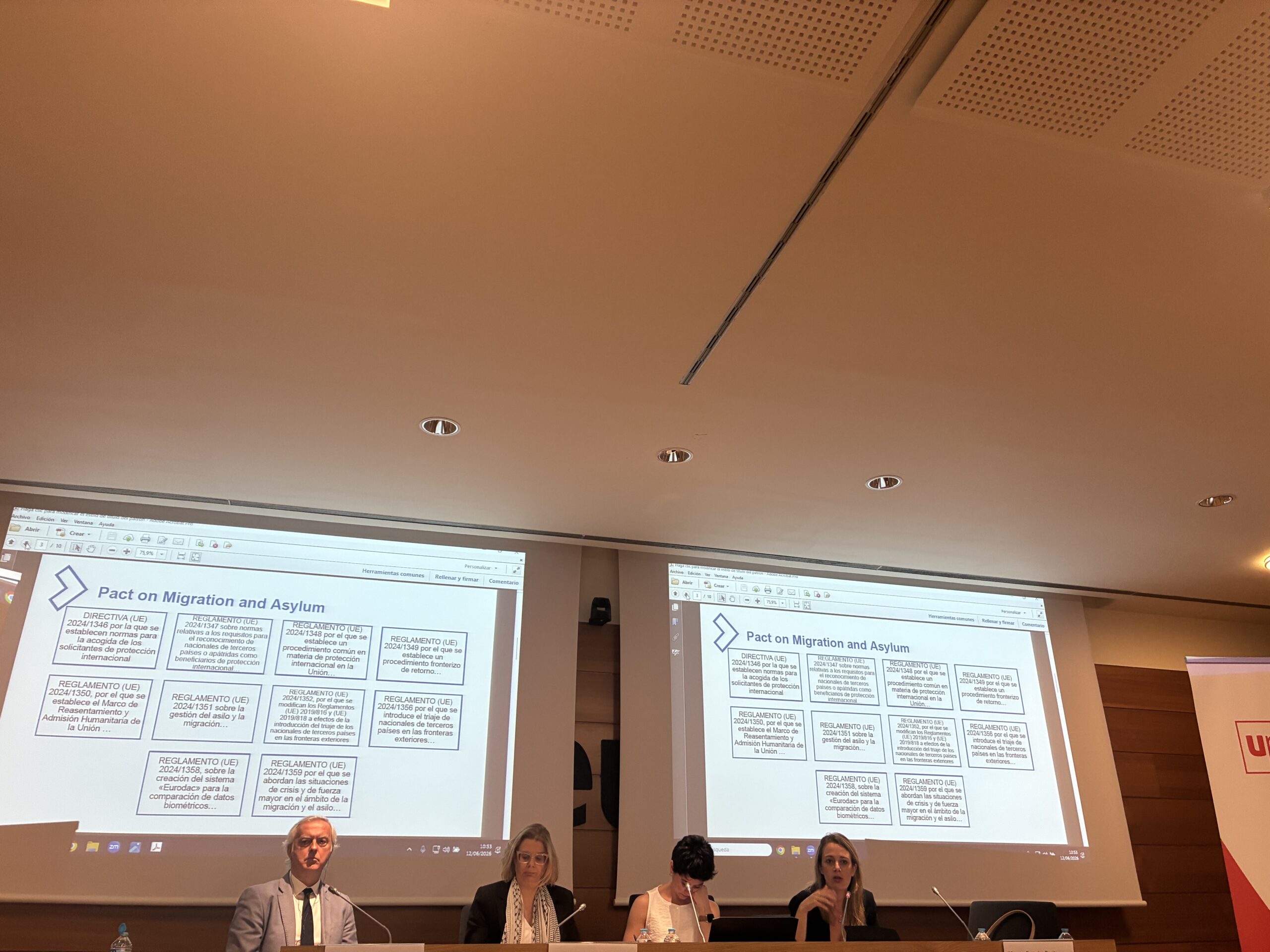

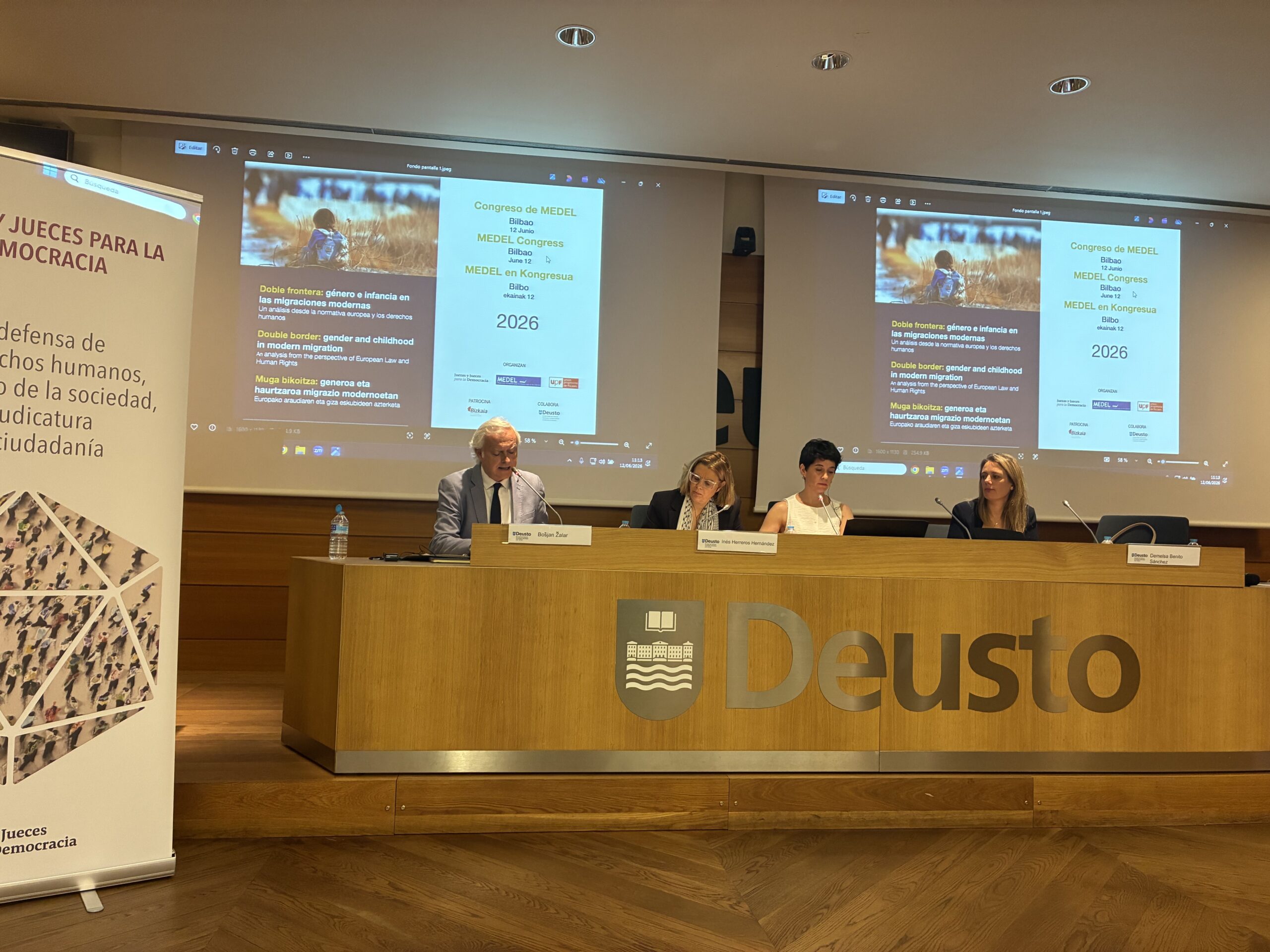

The presentation by Bostjan Zalar – Senior High Court Judge at the Administrative Court of the Republic of Slovenia, Immediate Past President of the European Chapter of the International Association of Refugee and Migration Judges, ad hoc judge of the European Court of Human Rights – at the International conference “Double Border: Gender and Childhood in Modern Migrations. European Regulations and Human Rights”, Bilbao, June 12,2026.
MEDEL Congress
“Double Border: Gender and Childhood”
University of Deusto, Bilbao, 12 June 2026
Asylum Law and Migration: Is European Law Working?
“Arguable Claim” in Relation to Prohibition of Inhuman Treatment and Protection of Privacy under Case Law of the CJEU and ECHR in the Light of the (Mandatory) Border Procedure under the Pact of Migration and Asylum[1]
Bostjan Zalar[2]
It is generally considered, especially by the EU Commission, that the (mandatory) border procedure will be the most challenging issue of the Pact on Migration and Asylum.[3] I would agree by adding that – not just concerning (mandatory) border procedure – the most challenging issue particularly for judges will be to integrate into the legal concept and rules of the Procedure Regulation 2024/1348 the existing standards of the rule of law that have been so far developed by the CJEU on Article 47 of the EU Charter of Fundamental Rights (hereinafter: the Charter) in conjunction with substantive Articles 4, 7 and 24 of the Charter and case law of the ECtHR, particularly on procedural dimension of Article 3 and Article 8 of the ECHR. That is why I put in the title of my presentation the notion “arguable claim”, which is a legal concept developed by the ECtHR and CJEU. It goes without saying that secondary EU law must be in line with the primary EU law on effective legal remedy and not vice versa.[4] Thus, the Grand Chamber of the CJEU in the case of Kinsa provided an interpretation that “the right of any third-country national or stateless person to make an application for international protection on the territory of a Member State, including at its borders or in its transit zones, even if he or she is staying illegally in that Member State, must be recognised, irrespective of the prospects of success of such a claim. When such an application is made, an applicant cannot, in principle, be regarded as staying illegally on the territory of the Member State concerned, so long as no decision has been given on that application at first instance, if the effectiveness of the right to asylum, as guaranteed by Article 18 of the Charter, is not to be compromised”.[5]
The Procedures Regulation is to apply from 12 June 2026 and it is to apply to the procedure for granting international protection in relation to applications lodged as from 12 June 2026.[6]
But, what exactly is the “meaning” of the term arguable claim in relation to Article 4 of the Charter (Article 3 of the ECHR) on prohibition of inhuman treatment or in relation to Article 7 of the Charter (Article 8 of the ECHR) on private an family life?
Arguable claim under case law of the ECtHR “means” that relevant consequences of possible violation of Article 3 of the ECHR “are not too remote“ or that the application of an individual prima facie can not be considered abusive, repetitive or entirely manifestly ill‑founded. The case of Ilias and Ahmed v Hungary shows that the legal concept of arguable claim is not limited only to situations when absolute right from Article 3 of the ECHR is involved. For more concrete examples of meaning of arguable claim, see point 1 of this presentation.
- The meaning of “arguable claim” in relation to Art. 3 of the ECHR under case law of the ECtHR:
Arguable claim means that relevant consequences of possible violation of Article 3 of the ECHR “are not too remote“[7] or when the applicants refer to the war and danger to their lives even if their statements are rather general depending on the country they come from[8] or when the applicant had asked for asylum /…/[9] or that the application prima facie can not be considered abusive, repetitive or entirely manifestly ill‑founded.[10]
With regard to asylum seekers whose claims are unfounded or, even more so, “who have no arguable claim about any relevant risk necessitating protection”, Contracting States are free, subject to their international obligations, to dismiss their claims on the merits and return them to their country of origin or a third country which accepts them. The form of such examination on the merits will naturally depend on the seriousness of the claims made and the evidence presented.[11]
The same approach to the meaning of arguable claim was adopted by the CJEU in the case of B from September 2020. The relevant reference is under point 2 of this presentation.
- The meaning of “arguable claim” in relation to Art. 4 of the Charter according to CJEU in the case of B:
Under case law of the CJEU arguable claim means that the enforcement of a return decision “may expose” a third-country national to a serious risk of ill-treatment, so that the applicant’s claim “does not appear to be manifestly unfounded”.[12]
Therefore, my first reaction to the question “Is European Law Working”, which is the title of this session, is the following: Does the “meaning” of arguable claim under case law of the CJEU and ECtHR correspond sufficiently to the Procedures Regulation? The answer is “Yes, it does,” theoretically speaking. There are provisions in the Procedures Regulation which can be with sufficient certainty related with the meaning of arguable claim under the existing case law of both European courts. These are, for example, provisions in the Procedures Regulation which direct administrative authorities and courts to obligatory use of country of origin information, provisions which use the expression “clearly inconsistent or contradictory or clearly false or obviously improbable representations” and expression which mention situations where issues of fact or law “are too complex to be examined” under the accelerated procedure. The examples of those provisions are listed under point 3.
- Possible link between provisions from the Procedures Regulation and the “meaning” of arguable claim under case law of ECtHR (Art. 3 ECHR) and CJEU (Art. 4 Charter):
- Accelerated examination procedure, first sub-paragraph of Article 42(b): /…/ the applicant has made „clearly inconsistent or contradictory or clearly false or obviously improbable representations“/…/;
- Article 42(2): where the determining authority considers that the examination of the application involves issues of fact or law that “are too complex to be examined” under an accelerated examination procedure /…/;
- Article 34 (2): The determining authority shall examine applications “objectively, impartially and on an individual basis”;
- Article 34((2)(b) and (c): obligatory use of country of origin or third country information (see also Articles 59(3), 59(6), 61(3)).
Therefore, up to this point, I see no problem (theoretically speaking) in the Procedures Regulation in relation to the Charter or the ECHR.
The next step in my analysis is that I need to define what are exact legal implications of the concept of arguable claim under case law of the ECtHR and CJEU and whether the Procedures Regulation fits in?
The first consequence of the legal concept of arguable claim is that a test for examination of a risk of being treated in contradiction with the right to prohibition of inhuman treatment in case of return must be “strict”; it must be thorough, rigorous.[13] A thorough/strict examination of a risk entails an obligatory use and a critical assessment of country of origin information. The full rigorous test is under point 4a of this presentation.
The second legal implication of arguable claim is that a legal remedy against a decision of an administrative authority to a court or tribunal in situations, when an applicant has an arguable claim in relation to Article 4 of the Charter, must have an automatic suspensive effect.
4.The two main legal implications of arguable claim under case law of the ECtHR (Art. 3 ECHR) and CJEU (Art. 4 Charter):
a.) A test for examination of a risk of being treated in contradiction with the right to prohibition of inhuman treatment in case of a return must be “strict/thorough/rigorous.”[14] A thorough/strict examination of a risk entails an obligatory use and a critical assessment of country of origin information. Risk must be assessed primarily with reference to facts which “were known or ought to have been known.”[15] General deficiencies well documented in authoritative reports, notably of the UNHCR, Council of Europe and EU bodies “are in principle considered to have been known”.[16] In assessing the weight to be attached to country material consideration must be given to the source of such material, in particular its independence, reliability and objectivity in respect of reports, the authority and reputation of the author, the seriousness of the investigations by means of which they were compiled, the consistency of their conclusions and their corroboration by other sources are all relevant considerations.[17] In assessing the risk, the ECtHR may obtain relevant materials proprio motu.[18] The assessment must focus on the foreseeable consequences of the applicant’s removal to the country of destination, in the light of the general situation there and of his or her personal circumstances.[19] Assessment of that risk is to some degree speculative.[20] Similarly, under EU law, the second independent instance (courts) must provide “full and ex nunc” examination of facts and law.[21] The CJEU says, too, that the degree of speculation is inherent in such a forward-looking assessment.[22]
b.) A legal remedy against a decision of an administrative authority to a court or tribunal in situations, when an applicant has an arguable claim in relation to Article 3 of the ECHR or in relation to Article 4 of the Charter must have ex officio an automatic suspensive effect[23] (as regards suspensive effect and Article 8 of the ECHR, see point 9 of this presentation).
Concerning those two legal implications or legal consequences I see major challenges in relation to the proper application of the Pact on Migration and Asylum in applying (mandatory) border procedure in line with primary EU law and case law of the CJEU and ECtHR. Namely, (mandatory) border procedure has a time limit of 12 weeks from the point when an application was registered and this includes the first instance court proceedings;[24] furthermore, a suspensive effect against decisions taken in accelerated examination procedure in the framework of asylum (mandatory) border procedure[25] is regulated in a very specific way.[26]
Hence, in respect of relation between rules on (mandatory) border procedure and legal concept of arguable claim it is importat already from the standpoint of secondary EU law that Article 51(2) of the Procedures Regulation says that “the border procedure shall be as short as possible while at the same time enabling a complete and fair examination of the claims.”[27] Following the aforementioned period of 12 weeks, the applicant shall be authorised to enter the Member State’s territory except where Article 4 of Regulation (EU) 2024/1349 applies.[28]
However, it needs to be highlighted that the aforementioned two legal implications of the concept of arguable claim are relevant in situations of any type of procedure: be it accelerated, subsequent procedure, procedure under safe country concept, border procedure, transfer to another Member State; it does not matter the type of decisions or procedure. This is covered under point 5 of my presentation.
- The two legal implications of arguable claim under special provisions of accelerated procedure, subsequent applications, safe country concept, transfer of applicant to another Member State:
The ECtHR acknowledges the need to ease the strain of the number of asylum applications received and in particular to find a way to deal with repetitive and/or clearly abusive or manifestly ill-founded applications for asylum, especially applications that are submitted immediately before a scheduled removal. However, given the absolute character of Article 3 of the ECHR, such difficulties cannot release a State from its obligations under that provision.[29] Therefore, if an applicant who submitted a subsequent application has an arguable claim in relation to Article 3 of the ECHR, the standard for rigorous/thorough scrutiny of a risk is applicable.[30] The same evidence law standard is applicable also for decisions taken in the so called accelerated procedure or fast track procedure at the border if the applicant has an arguable claim particularly (but not exclusively) in relation to Article 3 of the ECHR (fr.: “lorsque l’article 3 est en jeu“),[31] or in cases of a transfer to another Member State.[32] This is relevant also for automatic suspensive effect.[33] As regards arguable claim and safe country concept, see: Sherov and others v Poland, which concerns refoulement of applicants to Ukraine,[34] M.A. and Z.R. V Cyprus,[35], which concerns an agrement between Cyprus and Lebanon and O.H. and others v Serbia, where applicants have been refouled to Bulgaria,[36] or the case Y.K. v Croatia, which relate to refoulement of applicant from Croatia to North Macedonia.[37] In these situations, too, the remedy must have an automatic suspensive effect.[38] See also mutatis mutandis Alace and Canpelli, C-758/24 and C-759/24 [GC], 1 Aug. 2025, paras. 66-88, 101.
As regards legal implications of the concept of arguable claim, there is one very important interplay between the first and the second legal implication of the legal concept of arguable claim. The reference under point 6 shows that in order to assess whether the enforcement of the return decision under appeal ‘may’ expose the person concerned to such a risk, a national authority is not called upon to determine whether the enforcement of that decision actually entails such a risk. The conditions for the application of automatic suspensive effect should not be confused with those for the success of the appeal against the return decision. This means that an obligation for a strict or a rigorous scrutiny of a risk is activated already where the application is not manifestly ill-founded and not where substantial grounds have been shown for believing that the person concerned will actually face a real risk of being subjected to inhuman treatment.
- The interplay between the first and the second legal implication of arguable claim from the standpoint of evidentiary standard of arguable claim:
In order to assess whether the enforcement of the return decision under appeal ‘may’ expose the person concerned to such a risk, a national authority is not called upon to determine whether the enforcement of that decision actually entails such a risk. The conditions for the application of automatic suspensive effect should not be confused with those for the success of the appeal against the return decision.[39]
However, there is also a very important element of separation between arguable claim in relation to rigorous examination of a risk and effective legal remedy with a suspensive effect.
- The relation between Article 3 ECHR and Article 13 ECHR (and Article 47 of the Charter):
If it can be demonstrated that the applicant had “arguable” claims under Articles 2 or 3 ECHR during the period in which he or she was under an imminent threat of removal, a subsequent loss of victim status under the substantive claim would not automatically and retrospectively dispense the State from its obligations under Article 13 of the ECHR.[40]
The CJEU decided that interpretation of the first paragraph of Article 47 of the Charter ensures a level of protection which does not disregard that guaranteed by Article 13 of the ECHR, as interpreted by the ECtHR.[41]
Hence, the fact that a substantive claim in relation to Article 3 of the ECHR is declared inadmissible does not necessarily exclude the applicability of Article 13 of ECHR on effective legal remedy and this has impact also on the interpretation of Article 47 of the Charter.
So, in my view, as this will be further explained in the second part of my presentation, the aforementioned two legal implications of arguable claim will be the major challenges for administrative authorities and for national courts, but also for both European courts. Hopefully, the European court, too, will be able to overcome all political pressures and difficulties that are already with us in this actual moment.
What about the right to privacy as this being a distinct right from the right to prohibition of inhuman treatment? The border line between inhuman treatment and protection of privacy could be very thin, particularly in cases where applicants have special health situation. Case-law of the ECtHR does not exclude that treatment, which does not reach the severity of Article 3, may nonetheless breach Article 8 of the ECHR in its private-life aspect where there are sufficiently adverse effects on physical and moral integrity on an individual (see point 8 in this regard).
- A comparison between threshold for inhuman treatment and for protection of privacy:
The ECtHR’s case-law does not exclude that treatment which does not reach the severity of Article 3 may nonetheless breach Article 8 in its private-life aspect where there are sufficiently adverse effects on physical and moral integrity. Mental health must also be regarded as a crucial part of private life associated with the aspect of moral integrity. The preservation of mental stability is in that context an indispensable precondition to effective enjoyment of the right to respect for private life.[42]
But, of course, there are some important difference, between Article 3 and 8 of the ECHR. Where Article 8 of the ECHR is involved, principle of proportionality and margin of appreciation come into play, because this is not an absolute right. As regards automatic suspensive effect in relation to Article 8 of the ECHR, it depends on the circumstances of the case. The two judgments of the ECtHR are relevant in regards suspensive effect of an appeal when Article 8 of the ECHR is involved. Khlaifia and others v Italy from 2016 and Ilias and Ahmed v Hungary from 2019 (see point 9 of this presentation).
- Suspensive effect in situations of arguable claim in relation to Art. 8 ECHR (or corresponding Art. 7 of the Charter):
- Khlaifia and others v Italy (2016): Where expulsions are challenged on the basis of alleged interference with private and family life, it is not imperative, in order for a remedy to be effective, that it should have automatic suspensive effect. Nevertheless, in immigration matters, where there is an arguable claim that expulsion threatens to interfere with the alien’s right to respect for his private and family life, Article 13 of the ECHR in conjunction with Article 8 requires that States must make available to the individual concerned “the effective possibility of challenging the deportation or refusal-of-residence order and of having the relevant issues examined with sufficient procedural safeguards and thoroughness by an appropriate domestic forum offering adequate guarantees of independence and impartiality”.[43]
- Ilias and Ahmed v Hungary (2019): The ECtHR observes that, with regard to asylum seekers whose claims are unfounded or, even more so, who have no arguable claim about any relevant risk necessitating protection, Contracting States are free, subject to their international obligations, to dismiss their claims on the merits and return them to their country of origin or a third country which accepts them. “The form of such examination on the merits will naturally depend on the seriousness of the claims made and the evidence presented.”[44]
- Article 5 of the Return Directive 2008/115 concerning the right to family life and private life has a direct effect.[45]
Thus, the EU legislator respected that according to the interpretation of the CJEU Article 5 of the Return Directive 2008/115 has a direct effect, since under Article 43(1)(c) of the Asylum and Migration Management Regulation 2024/1356 applicants shall have the right to an effective remedy against decisions which infringe their private or family life.
At the end of this first part of presentation it is worth noting that references to the case law of the ECtHR must be taken as minimum standards from the standpoint of EU law meaning that Article 52(3) of the Charter shall not prevent Union law providing more extensive protection as it is guaranteed under ECHR.[46] This is particularly relevant in cases where a dispute concerning a return of third-country nationals affects a child who is EU citizen so that Article 20 of the Treaty on Functioning of EU is at stake. Such situations invoke very specific EU law standards that have been established in the preliminary ruling in the case of Zambrano[47] and case law of the CJEU which followed that judgment.[48] In addition, in relation to both Articles 3 and 8 of the ECtHR the principle of subsidiarity is applicable[49] and it is expected that subsidiarity will get some more momentum in the future case law of the ECtHR. On the later see points 16 and 17 of this presentation.
* * * *
Taking into account the legal implications of arguable claim discussed in the first part of my presentation it needs to be answered in more concrete terms why it is expected that the (mandatory) border procedure under the Procedures Regulation will be a challenge (particularly for judges) or why a (mandatory) border procedure could be a problematic stage in the whole procedure.
The fact is that a border procedure was regulated already in the Procedure Directive from 2005 (Article 35) and in the Procedure Directive from 2013 (Article 43). The right to effective legal remedy against decisions taken in the border procedure was well regulated in the Procedure Directive 2013/32 (Article 46, paragraphs 6 and 7). However, under the Procedures Regulation there are some important differences in comparison to the Procedure Directive 2013/32.
The first important difference is that the border procedure is now mandatory in certain defined situations and those situations contain also a criterion under Article 42(1)(j) – if an applicant is coming from the country for which the proportion of decisions by the determining authority granting international protection is statistically defined as 20 % or lower. In addition, a circumstance under Article 42(1)(f) could be interpreted and applied by determining authorities extensively – “where there are reasonable grounds to consider the applicant a danger to the national security or public order of the Member States“. Article 43(1)(b) of the Procedures Regulation, too, could be interpreted more or less restrictively. That is why it is so important that national authorities and courts will consider the existing case law of the CJEU on the aforementioned legal notions in order to apply Article 42((1)(f) and Article 43(1)(b) properly. See point 10 of this presentation.
- Mandatory border procedure (Article 45(1) of the Procedures Regulation):
- A Member State “shall” examine an application in a border procedure where any of the circumstances from Article 42(1)(c), (f) and (j) applies. Point f.) contains the notion “danger to the national security or public order“[50] and point (j) includes that the applicant comes from the country for which the proportion of decisions by the determining authority granting international protection is 20 % or lower, unless the determining authority assesses that a significant change has occurred in the third country concerned since the publication of the relevant Eurostat data or that the applicant belongs to a category of persons for whom the proportion of 20 % or lower cannot be considered to be representative for their protection needs, taking into account, inter alia, the significant differences between first instance and final decisions.
- Further conditions for mandatory border procedure under Article 43(1) of the Procedures Regulations are as follows: (a) following an application made at an external border crossing point or in a transit zone; (b) following “apprehension in connection with an unauthorised crossing of the external border”;[51] (c) following disembarkation in the territory of a Member State after a search and rescue operation; (d) following relocation in accordance with Article 67(11) of Regulation (EU) 2024/1351.
- A particular “location” for carrying out the asylum border procedure seems not to be a condition for a border procedure.[52]
Exceptions to the asylum border procedure are regulated in a restrictive manner (see Article 53 of the Procedures Regulation). Furthermore, the original EU legislator’s idea of (mandatory) border procedure was to introduce a mechanism which would help to quickly identify the category of asylum seekers who are not worthy of international protection and to ensure their swift returns.[53] The version of proposed rules on border procedure from 2020 in comparison to proposed rules on border procedure from 2016 significantly expanded the use of border procedure and the aims were to ensure that asylum seekers are kept at the borders with their applications examined there swiftly and to prevent secondary movements within the EU by assigning responsibility for handling those applications to the country of first entry.[54]
For the illustration, according to the Commission Implementing Decision from August 2024, Italy will have an obligation to conduct more than 16.000 border procedure in 1 year, Hungary more than 15.400, Spain 6600, Greece more than 4300, Croatia almost 3000, Poland 3100.
The second important difference in comparison to border procedure under the Procedure Directive 2013/32 is that there is a time limit of 12 weeks to conclude a border procedure and this includes first independent instance proceedings. This will cause huge challenges for courts and tribunals, because national courts and/or tribunals will have to bring a variety of decisions/judgments during a border procedure concerning the same applicant. There could be one or two or even more subsequent judicial decisions on control of detention and/or restriction of freedom of movement during screening process and during border procedure, since legal grounds can be changed; perhaps, a (separate) decision on identification of applicants in need of special procedural guarantees and who can not be subject to border procedure will be needed; then, there will be a decision on free legal assistance and representation in the appeal procedure; a next decision will be on the right to remain during court’s proceedings; the later will be followed by a judgment based on appeal against administrative decisions on international protection and return (see point 11 of the presentation).
- Mandatory numbers of border procedures per year[55] and a variety of courts’ decisions during (mandatory) border procedure within defined time limit:
a.) Italy: at least 16032 mandatory border procedures per year; Hungary: at least 15432 mandatory border procedures per year; Spain 6602; Greece 4376 …
b.) Further challenges for courts and tribunals relate to decisions of judicial control of detention and/or restriction of freedom of movement during screening process,[56] during (mandatory) border procedure, after application for international protection is rejected in the border procedure[57] based on different legal grounds in the Screening Regulation 2024/1349, in the Return Border Procedure Regulation 2024/1349, in the Recast Reception Directive 2024/1346 and in the Return Directive 2008/115;[58] identification of applicants in need of special procedural guarantees (Article 21 of the Regulation 2024/1348) and can not be subject to border procedure (see Article 53 of the Procedures Regulation); courts’ decisions on free legal assistance and representation in the appeal procedure (Article 17 of the Procedure Regulation); decision on the right to remain during court’s proceedings (Article 68(4) of the Procedure Regulation) and a decision based on appeal against administrative decisions on international protection and on return (third sub-paragraph of Article 67(1)).
Some national courts will be competent to adjudicate on all the above mentioned matters and it is doubtful that additional and proportionate human and financial resources will be given to competent courts in order to complete those judicial tasks in efficient manner.
The next very serious practical danger for the rule of law lies in a prediction that determining authorities might not take seriously enough case law of the Grand Chamber of the CJEU concerning its interpretation that examination of the application for international protection by an administrative body, which has specific resources and is specialised, is „a vital stage“ of the common procedures. Legal answer to the question why the procedure before the determining authority is a vital stage is provided under point 12 of this presentation.
- The examination by the determining authority is a “vital stage” of the common procedures:
The examination of the application for international protection by an administrative or quasi-judicial body with specific resources and specialised staff in this area is „a vital stage“ of the common procedures established by that directive.[59] Personal interview is accompanied by specific guarantees intended to ensure the effectiveness of that right, for example: the personal interview is to take place under conditions which ensure appropriate confidentiality; the person who conducts the interview is competent to take account of the personal and general circumstances surrounding the application, including the applicant’s cultural origin, gender, sexual orientation, gender identity or vulnerability; the directive requires Member States to provide, wherever possible, for the interview with the applicant to be conducted by a person of the same sex etc.[60] Depending on national system, it cannot be guaranteed, owing to national rules governing judicial procedure, that all of the conditions under which the personal interview is to be conducted, will be complied with in a hearing held before the appeal court or tribunal.[61]
Therefore, it may be expected that administrative authorities will not apply strict scrutiny test in situations where applicant will have an arguable claim. Consequently, everything as regards the essence of the rule of law challenges will be on courts (or tribunals) and courts will be under huge political pressures because of 12 weeks maximum duration of border procedure. Namely, after 12 weeks deadline will expire, applicants will get a right to enter the territory and it cannot be excluded that the (public) blame will be on courts. Although it is directly relevant also for challenges of courts and tribunals, it is beyond the scope of this presentation to question or analyse whether legal representatives of asylum seekers in reality will have sufficient conditions to provide quality legal representation in court proceedings.[62]
However, it needs to be pointed out that no matter what kind of administrative decision from Article 67(1) and (2) is contested (with the exception of a decision based on Article 66(6)) in court proceedings,[63] national courts and tribunals will have to provide “a full and ex nunc examination of both facts and points of law, at least before a court or tribunal of first instance, including, where applicable, an examination of the international protection needs pursuant to Regulation (EU) 2024/1347.”[64] Since the text of the Article 46(3) of the Procedure Directive 2013/32 is the same as the text of Article 67(3) of the Procedures Regulation, this means that the existing case law on Article 46(3) of the Procedures Direcitve 2013/32 in conjunction with Article 47 of the Charter is relevant also for the interpretation of Article 67(3) of the Procedures Regulation.[65] Hence, the existing interpretations of the legal notions, such as “full examination” (of facts and law), “ex nunc examination”, “the definition of the scope and rigorousness of the examination”, “subjective dimension and an objective dimension of well-founded fear of being persecuted”, “reasonable likelihood” in the case law of the CJEU will be relevant also in the context of Procedures Regulation.[66] The CJEU says: “Regarding the assessment of the question whether an applicant for international protection has a well-founded fear of being persecuted, the Court has emphasised that such an assessment must be carried out with vigilance and care, as what are at issue are questions relating to the integrity of the person and to individual liberties, questions which relate to the fundamental values of the Union”.[67]
Only from a technical point of view, it is worth mentioning that the Grand Chamber of the CJEU in the case on border procedure under Article 43 of the Procedure Directive 2013/32 decided that a specific border procedure must be carried out within a reasonable time and if a decision rejecting the application for international protection has not been taken within a period of four weeks, the Member State concerned must grant the applicant entry to its territory and the application must be dealt with after that four-week period in accordance with “the normal procedure.”[68] This may be relevant also for the interpretation of legal consequence in situation when a time limit for accelerated procedure under Procedures Regulation expires.[69]
The next danger or problem as regards the rule of law in relation to the role of judges under the so called (mandatory) border procedure is a regulation of (non) suspensive effect of an appeal to a second independent instance.
As regards (non) suspensive effect of an appeal it needs to be distinguished between two basic situations given that the text of Article 68(2) and Article 68(5)(d)(ii) are clearly different. Under circumstances of Article 68(2) of the Procedures Regulation it is enough for a suspensive effect to be “confirmed”[70] that the applicant exercises the right to effective legal remedy within the prescribed time limit. On the other hand, under circumstances of Article 68(3), (4) and (5) in order that suspensive effect is “confirmed” the applicant must first request the court or tribunal to be allowed to remain on the territory pending the outcome of the remedy, which he/she must do within five days from the date on which the decision is notified to the applicant and under further condition that the court or tribunal grants that request following an examination of both facts and points of law; only during those 5 day time limit, there is an automatic suspensive effect of an appeal.[71]
Circumstances under which suspensive effect depends on a request of an applicant and on a substantive examination of a court are extensively defined in Article 68(3) of the Procedures Regulation and decisions taken in (mandatory) border procedures is only one of several circumstances listed in that provision. Those circumstances among other decisions include decisions which reject an application as unfounded or manifestly unfounded „if at the time of the decision“ the applicant is subject to an accelerated examination pursuant to Article 42(1) or (3) or the applicant is subject to the border procedure (see point 13 of this presentation).
- Right to remain and suspensive effect of legal remedy against decisions of determining authority under the Asylum Procedure Regulation:
a.) Article 10: Applicants shall have the right to remain on the territory of the Member State in which they are required to be present /…/ until the determining authority has taken a decision on the application in the administrative procedure.
b.) Automatic suspensive effect under Article 68(2): Applicants shall have the right to remain on the territory of the MS until the time limit within which they can exercise their right to an effective remedy before a court of first instance has expired and, where such a right has been exercised within the time limit, pending the outcome of the remedy.
c.) No automatic suspensive effect under Article 68(3), but /…/„without prejudice to the principle of non-refoulement“ /…/;
d.) Article 68(4) and Article 68(5)(a): In the cases referred to in Article 68(3), a court shall have the power to decide, following an examination of both facts and points of law, whether or not the applicant /…/ should be allowed to remain on the territory of the Member States pending the outcome of the remedy, upon the request of the applicant /…/ The competent court or tribunal shall under national law have the power to decide on this matter ex officio. The applicant /…/shall have a time limit of at least five days from the date on which the decision is notified to him or her to request to be allowed to remain on the territory pending the outcome of the remedy.
e.) Article 68(5)(d): the applicant shall not be removed from the territory of the Member State responsible until the time limit for requesting a court or tribunal to be allowed to remain has expired; where the applicant has requested to be allowed to remain within the set time limit, pending the decision of the court or tribunal on whether or not the applicant or the person subject to withdrawal of international protection shall be allowed to remain on the territory.
f.) See also: Article 68(6) (and mutatis mutandis paragraph 7): – „without prejudice to the principle of non-refoulement“ /…/;
This means that most often the applicant, represented by a lawyer, will first file a request to the court to allow him/her to remain and after that he/she will file an appeal to the court against the administrative decisions. In theory this is fine with the rule of law, but practice will show whether courts will be capable to manage multiple decisions (mentioned under point 11.b of this presentation) in respect of at least minimum requirements of the rule of law.
The logic of Article 68 of the Procedures Regulation, which is very cryptic, if it is interpreted in conjunction with the existing case law of the CJEU on Article 47 of the Charter[72] would be that if time limit for accelerated procedure or border procedure expires before an administrative decision is taken, then guarantees for automatic suspensive effect under Article 68(2) of the Procedures Regulation are applicable.
Hence, in my view, it is possible to apply Article 68 of the procedure Regulation in line with the Article 47 of the Charter and with substantial articles, such as Article 4 of the Charter (including its procedural dimension), Article 7 and 24 of the Charter, which most often come into play in asylum and migration disputes.
As regards protection of automatic suspensive, which is a legal implication of arguable claim, it is possible even to be slightly optimistic. Namely, one needs to distinguish between the right to remain, which is a legal concept of secondary EU law and protection of non-refoulement, which is a legal concept of primary EU law.[73] Protection of non-refoulement is binding also for the administrative authority and not only for the courts and tribunals. In other words, the right to remain under Procedures Regulation must be interpreted and applied by administrative authorities in line with the case law of the CJEU and the ECtHR concerning non-refoulement. Thus, under point 14 of this presentations examples of provisions in the Procedure Regulation, which impose an obligation on the administrative authority to respect the principle of non-refoulement, are listed.
- Examples of provisions in the Procedures Regulation which impose an obligation on the administrative authority to respect (and protect) the principle of non-refoulement (in conjunction with the right to remain):
- Article 10(4)(a) in conjunction with 65(1) – “without prejudice to the principle of non-refoulement“;
- Article 10(4)(c) – /…/ „in violation of the principle of non-refoulement“;
- Article 10(5) – /…/ „will not result in direct or indirect refoulement in breach of the obligations of that Member State under international and Union law“;
- Article 34(1) – /…/ the determining authority shall examine and take decisions on applications for international protection in accordance with the basic principles and guarantees set out in Chapter II.
- Article 37 – /…/ Member States shall issue a return decision that respects Directive 2008/115/EC and that is in accordance with the principle of non-refoulement;
- Article 43(1), see also Article 45(1) – /…/ a Member State may, in accordance with the basic principles and guarantees of Chapter II, examine an application in a border procedure“ /…/;
- Article 56(1) – „without prejudice to the principle of non-refoulement“ /…/;
- See also Articles 58(5), 59(1)(c), 61(4(b) of the Procedure Regulation as well as Articles 68(3), 68(6) and (7)
Under point 15 I have selected several principles of application of EU law or methods of interpretation of EU law that according to my experiences and predictions will be the most strategic in applying the Pact on Migration and Asylum properly.
- Projection about the most strategic principles of application or/and methods of interpretation of EU law, which will be relevant for national judges in relation to proper interpretation and application of the Pact on Migration and Asylum:
a.) In a situation that a change of secondary EU law not having resulted in any change in the legal rules for a particular legal subject (or as regards the numbering of the relevant provisions), the case-law concerning the old secondary EU law is relevant for interpreting new secondary EU law.[74]
b.) The Member States must not only interpret their national law in a manner consistent with EU law but also make sure they do not rely on an interpretation of an instrument of secondary legislation which would be in conflict with the fundamental rights protected by the European Union legal order or with the other general principles of European Union law.[75] In accordance with a general principle of interpretation, an EU measure must be interpreted, as far as possible, in such a way as not to affect its validity and in conformity with primary law as a whole and, in particular, with the provisions of the Charter.[76]
c.) This entails, in particular, the obligation for national courts to change established case-law, where necessary, if it is based on an interpretation of national law that is incompatible with the objectives of a directive. Consequently, a national court cannot, in particular, validly claim that it is impossible for it to interpret a provision of national law in a manner that is consistent with EU law merely because that provision has consistently been interpreted in a manner that is incompatible with EU law. Any provision of a national legal system and “any legislative, administrative or judicial practice” that might impair the effectiveness of EU law by withholding from the national court with jurisdiction to apply that law the power to do everything necessary at the moment of its application to set aside national legislative provisions that might prevent EU rules which have direct effect from having full force and effect are incompatible with those requirements, which are the very essence of EU law.[77] It is not necessary for the national court to request or await the prior setting aside of such national provision by legislative or other constitutional means.[78]
d.) If a national court considers that the ground put forward by the party in support of invalidity of a particular provision of secondary EU law is unfounded, a national court may reject that argument by concluding that the provision is completely valid.[79] But, a national court has no jurisdiction to declare measures taken by the EU institutions invalid.[80]
e.) In legal situations where Member States have procedural autonomy this principle comprises of two requirements: national procedural rules should not be less
favourable than those governing similar domestic actions (“principle of equivalence”) and they should not render virtually impossible or excessively difficult the exercise of rights conferred by EU law (principle of effectiveness).[81]
f.) The explanations relating to Article 52 of the Charter indicate that paragraph 3 of that article is intended to ensure the necessary consistency between the Charter and the ECHR, ‘without thereby adversely affecting the autonomy of Union law and that of the CJEU.[82]
g.) Article 267 of the TFEU (rules on preliminary ruling).
In the final part of my presentation, I promised to the organiser of this conference that I will say few things about the recently adopted Chisinau declaration and its potential impact on future case law of the ECtHR. The political process related to Chisinau declaration definitely was not a sophisticated way to impact the case law of the ECtHR in the field of asylum and migration. The letter of 8 prime ministers and one president of 9 Member States from May 2025 had definitely certain impact, which is hard to measure. That letter was later reinforced by the Joint Statement to the Conference of 27 Ministers of Justice of the Council of Europe on 10 December 2025. The process ended on 15 May in Chisinau with a Political Declaration specifically aiming to migration related issues.
- Political process of Chişinău Declaration and related preassures on ECtHR concerning future interpretations of the ECHR and ECtHR’s supervision of national decision/judgments in asylum and migration cases:
- Letter from 22 May 2025 of 8 prime ministers and 1 president of the Member States of the EU;
- Joint Statement to the Conference of 27 Ministers of Justice of the Council of Europe from 10 December 2025;
- Chişinău Declaration, Committee of Ministers CM(2026)99-final, 135th Session, 15 May 2026.
So, what are my expectations about possible impact of Chişinău political process on future case law of the ECtHR?
- „Expectations“ about possible impact of Chişinău political process on future case law of the ECtHR[83]:
- I do not think that the ECtHR in its future case law will change its basic interpretations and principles as regards rights from the ECHR because of the Chişinău political process.
- Highly probably, the ECtHR will be more attentive to use the principle of subsidiarity in a consistent manner as regards Article 3[84] and Article 8[85] of the ECHR.
- However, it might happen that in the future the outcome of cases in the proceedings before the ECtHR concerning (non)violation of Article 3 of the ECHR will (from time to time) depend perhaps to a greater extent as it was the case in the past on a harsh assessment of evidence made by the ECtHR in each individual case in situations when the ECtHR will provide ex nunc examination of facts and circumstances concerning a real risk,[86] or when the ECtHR will assess (in)human conditions in detention facilities;[87]
- The so called “conduct” of the applicant or “freedom of choice” of an applicant might get some additional momentum in the future case law of the ECtHR: see, for example, some previous cases in this regards: jurisdiction under Article 1 of the ECHR;[88] detention under Article 5 of the ECHR;[89] private and family life under Article 8 of the ECHR;[90] prohibition of collective expulsion under Article 4 Protocol 4 of the ECHR;[91] while the CJEU has started to use the concept of conduct/choice of the applicant also in relation to the prohibition of inhuman or degrading treatment already in 2019,[92] some first signs for using this concept are identifiable in case law of the ECtHR only recently.[93]
- a reliance on a particular “context” might get some additional momentum in the future of case law of the ECtHR; see for example: Mansouri v Italy [GC] 63386/16, 29 April 2025, para. 113; see also the importance of the „context„ in migration dispute with national security concerns in the case of H.F. and others v France [GC], 24384/19 and 44234/20 (14. 9. 2022, para. 210-211) or in situation of extradition in the case of Sanchez and Sanchez v the United Kingdom (22854/20, 3 Nov. 2022, paras. 91-95) or in situations of sudden flows of migrants.[94]
[1]This is a revised version of the invited presentation that was given by the author at the international conference entitled: „Double Border: Gender and Childhood in Modern Migrations, European Regulations and Human Rights”, University of Deusto, Bilbao, 12. June 2026, organised by MEDEL, Judges for Democracy and Progressive Union of Prosecutors. I am grateful to my colleague Martina Greif for her very helpful comments on the revised version of this presentation.
[2]Immediate Past President of the European Chapter of the International Association of Refugee and Migration Judges (IARMJ-Europe); Co-Chair of the Special Interest Group on Fundamental Rights at the European Law Institute (ELI, Vienna), member of a network of national experts on application of the Charter of Fundamental Rights of the EU Fundamental Rights Agency (FRA); member of the Network of Courts and Tribunals of the EU Agency for Asylum (EUAA); ad hoc judge of the European Court of Human Rights; Senior High Court Judge, at the Administrative Court of the Republic of Slovenia; lecturer at the Legal Clinics on Refugee Law, Faculty of Law, University of Ljubljana.
[3]There are (non) mandatory border procedures in the Regulation (EU) 2024/1348 of the European Parliament and of the Council of 14 May 2024 establishing a common procedure for international protection in the Union and repealing Directive 2013/32/EU, O J L 22. 5. 2024; hereinafter: the Procedures Regulation). According to Article 43(1) of the Procedures Regulation Member States „may“, in accordance with the basic principles and guarantees of Chapter II, examine an application in a border procedure where that application has been made by a third-country national or stateless person who does not fulfil the conditions for entry to the territory of a Member State as set out in Article 6 of Regulation (EU) 2016/399. The border procedure may take place: following an application made at an external border crossing point or in a transit zone; following apprehension in connection with an unauthorised crossing of the external border; following disembarkation in the territory of a Member State after a search and rescue operation; following relocation in accordance with Article 67(11) of Regulation (EU) 2024/1351. Mandatory border procedure is regulated in Article 45(1) of the Procedures Regulation.
[4]See, for example: OB [Kinsa], C-460/23, 3 June 2025, para. 60.
[5]Ibid. para. 61.
[6]PM and others [Ebilum], C-440/25, 4 June 2026, para. 31.
[7]Soering v. U.K., [GC], App. no. 14038/88, 7 July 1989, paras. 85, 117.
[8]L.M. and others v Russia, App. no. 40081/14, 15 Oct. 2015, para. 104.
[9]M.A. and others v. Lithuania, App. no. 57993/17, 11 Dec, 2018, paras, 66, 83; see also: Ilias and Ahmed v. Hungary [GC], App. no. 47287/15, 21 Nov. 2019, para. 136.
[10]Mohammed v Austria, App. no. 2283/21, 6 June 2013, para. 80.
[11]Ilias and Ahmed [GC], App. no. 47287/15, 21 Nov. 2019, para. 136.
[12]B, C-233/19, 30. Sept. 2020, paras. 63-66.
[13]Soering v. the U.K., [GC], App. no. 14038/88 , 7 July 1989, para. 91; J.K. and others v. Sweden [GC], App. no. 59166/12, 23 Aug. 2016, paras. 51, 83, 86.
[14]Soering v. the U.K., [GC], App. no. 14038/88 , 7 July 1989, para. 91; J.K. and others v. Sweden [GC], App. no. 59166/12, 23 Aug. 2016, paras. 51, 83, 86.
[15]Hirsi Jamaa and others v. Italy, [GC], App. no. 27765/09, 23. 2. 2012, paras. 31, 137; J.K. and others. Sweden [GC], App. no. 59166/12, 23 Aug. 2016, para. 87.
[16]Ilias and Ahmed v. Hungary [GC], App. no. 47287/15, 21 Nov. 2019 , para. 141; N.S. and M.E. [GC], C-411/10 and C-493/10 [GC], paras. 94, 106; C.K. and others v. Slovenia, C-578/16 PPU, para. 60; Jawo, C-163/17 [GC], para, 85.
[17]Mamatkulov and Askarov v. Turkey [GC], App. no. 46827/99 and 46951/99, para. 67; Saadi v Italy, [GC], App. no. 37201/06, 28 Feb, 2008, para. 143; J.K. and others v Sweden [GC], App. no. 59166/12, 23 Aug 2016, para, 87, 83, 90.
[18]J.K. and others v Sweden [GC], App. no. 59166/12, 23 Aug 2016, para. 90.
[19]Ibid. para. 86.
[20]Saadi v Italy [GC], App. no. 37201/06, 28 Feb. 2008, para. 142.
[21]Moussa Sacko, C-348/16, 26 July 2017, paras. 42-49; Alheto, C-585/16, [GC], 25 July 2018, paras. 106, 110-118; Torubarov, [GC], C-556/17, 29 July 2019, paras. 51-78; Ahmedbekova, C-652/16, 4 Oct. 2018, paras. 92-103; see also Article 46(3) of the Procedure Directive 2013/32 and Article 67(3) of the Procedues Regulation.
[22]X [GC], C-69/21, 22 Nov. 2022, para. 73.
[23]Soering v. the United Kingdom, [GC], App. no. 14038/88, 7. 7. 1989, odst. 31, 90, 111; Mamatkulov and Askarov v Turkey, App. no. 46827/99 and 46951/99, 4. 2. 2005, odst. 107-108, 124; Kebe and others v. Ukraine, App. no. 12552/12, 12. 1. 2017, odst. 101; DeSouza Ribeiro v France [GC] App. no. 22689/07, 13. 12. 2012, odst. 82; Khlaifia and others v Italy, App. no. 16483/12, 15. 12. 2016, odst. 276, 279-280; Y.K. v Croatia, App. no. 38776/21, 17. 7, 2025, odst. 104; N.R. v Türkiye, App. no. 5137/19, 23. 10. 2025, odst. 27; M.S.S. v. Belgium and Greece [GC], App. no. 30696/09, 21 Jan. 2011, para. 293; B, C-233/19, 30 Sept. 2020, paras. 46, 48-51, 57, 61-65.
[24]In case of a transfer of an applicant based on Regulation 2024/1351 on asylum and migration management this may be extended to 16 weeks. See Article 51(2) of the Procedures Regulation. See also exception under Article 1(4) of Regulation 2024/1359 (situations of crisis and force majeure).
[25]These are decisions on the inadmissibility of an application and on the merits of an application where any of the circumstances of accelerated examination procedure referred to in Article 42(1), points (a) to (g) and (j), and Article 42(3), point (b), apply.
[26]See Article 68 of the Procedures Regulation.
[27]See also: PM and others [Ebilum], C-440/25, 4 June 2026, para. 50.
[28]Article 51(2) of the Procedures Regulation. According to Article 4 of the Regulation 2024/1349 (return border procedure) third-country nationals and stateless persons whose application has been rejected in the context of the asylum border procedure shall not be authorised to enter the territory of the Member State concerned.
[29]A.M.A. v the Netherlands, App. no. 23048/19, 24 Oct. 2023, para. 69.
[30]See ibid. paras. 70-79; see also: LH, C-921/19, 10 June 2021, paras. 40-66.
[31]See, for example: E.H. v France, App. no. 39126/18, 22 July 2021, para. 179; S.H. v Malta, App. no. 37241/21, 20 Dec. 2020, paras. 80-99.
[32]See: H.T. v Germany and Greece, App. no. 13337/19 15 Oct. 2024, para. 138. In case that an applicant has an arguable claim in relation to Article 3 of the ECHR, the evidence law standard from the case law of the ECtHR mentioned above contradicts a different evidence law standard (the so called two-steps approach), which relates to the principle of mutual trust under EU law given that under Dublin Regulation 604/2013 Member States have a discretion to transfer or not to transfer an applicant to another Member State (Article 17 of the Dublin Regulation 604/2013) and thus principle of equivalent protection under ECHR is not applicable. For more on this, see: Zalar, B., 2022, “Judicial test(s) in the field of asylum-related disputes for assessing deficiencies in another Member State affecting the fundamental rights of an individual under the principles of mutual trust (EU law) and presumption of equivalent protection (ECHR),” in: Filzwieser, C., Kasper, L., (eds.) Asyl und Fremdenrecht Jahrbuch 7, NWV Verlag, pp. 309-325.
[33]See, for example: M.S.S. v. Belgium and Greece [GC], App. no. 30696/09, 21. 1. 2011, odst. 293; H.T. v Germany and Geece, App. no. 13337/19, 15. 10. 2024, odst. 121, 141-154.
[34]Sherov and others v Poland, App. no. 54029/17, 4 April 2024, paras. 43-50.
[35] App. no. 39090/20, 8 Oct. 2024, paras. 91-95.
[36]App. no. 57185/17, 3 Feb. 2026, paras. 143-149.
[37]App. no. 38776/21, 17 July 2025, paras. 89-93, 113-123.
[38]App. no. Sherov and others v Poland, 54029/17, 4 April 2024, para. 49; Y.K. v Croatia, App. no. 38776/21, 17 July 2025, para. 104, 131.
[39]B, C-233/19, 30. 9. 2020, paras. 64-65. The evidentiary standard for protection of the right from Article 3 of the ECHR or from Article 4 of the Charter is the following: /…/ where substantial grounds have been shown for believing that the person concerned faces a real risk of being subjected to torture or inhuman or degrading treatment or punishment in the receiving country (Soering v. the United Kingdom [GC] App. no. 14038/88, 7 July 1989, paras. 90-91; Paposhvili v Belgium, [GC] App. no. 41738/10, 13. Dec. 2016, para. 173; D.M. v Sweden, App. no. 32694/23, 26 March 2026, para. 146 C.K. and others v. Slovenia, C-578/16 PPU, 16 Feb. 2017, paras. 73-74; Jawo [GC], C-163/17, 19 March 2019, para. 87; Torubarov [GC], C-556/1, 29 July 2019, para. 49; X [GC], C-69/21, 22 Nov. 2022, para. 56).
[40]N.R. v Türkiye, App. no. 5137/19, 23 Oct. 2025, paras. 27, 35; Khlaifia and others v Italy [GC], App. no. 16483/12, 15. Dec. 2016, para. 269.
[41]X and Y, C-180/17, 26 Sept. 2018, para. 31; Moussa Sacko, C-348/16, 26 July 2017, para. 39.
[42]Savran v Denmark [GC], App. no. 57467/15, 7 Dec. 2021, para. 172; compare this with cases concerning threshold for inhuman treatment: Paposhvili v Belgium App. no. 41738/10, 13. De. 2021, para. 131; X, C-69/21 from 22 Nov. 2022, paras. 63-66, 71; MP, C-353/1624, April 2018, para. 40.
[43]Khlaifia and others v Italy [GC], App. no. 16483/12, 15. 12. 2016, para. 278.
[44]Ilias and Ahmed v Hungary [GC], App. no. 47287/15, 21. 11. 2019, para. 136; see, for example: Othman (Abu Qatada) v the United Kingdom, App. 8139/09, 16. 1. 2012, para. 258-259; L.G., C-745/21, 16.2.2023 (mutual trust under Dublin Regulation 604/213), paras. 49-54; XXXX, C-483/20 [GC] 22.2.2022 (mutual trust under Procedure Directive 2013/32), paras. 35-44. See also Article 43(1)(c) of Regulation 2024/1351 on asylum and migration management.
[45]M.D., C-528/21, 27 April 2023, para. 97; X, C-69/21 [GC], 22. Nov. 2022, paras. 90-92
[46]Article 52(3) of the Charter.
[47]C-34/09, 8 March 2011.
[48]This remark is given in general and not specifically in relation to eventual border procedures. See, for example, cases such as: Chavez-Vilchez and others, C-133/15, 10 May 2017; Marin, C-165/14, 13 Sept. 2016; X, C-459/20, 22 June 2023; K.A. and others, C-82/16, 8 May 2018; XU and QP, C-451/19 and C-532/19, 5 May 2022.
[49]As regards subsidiarity and procedural dimension of Article 3 of the ECtHR, see for example: F.G. v Sweden [GC], 43611/11, 23 March 2015, paras. 117-118; Khasanov and Rkhmanov[GC], 28492/15 and 49975/15, 29 April 2022 paras. 102-105; D.M. v Sweden 32694/23, 26 March 2026, 152-153. As regards subsidiarity and Article 8 of the ECTHr, see for example: Savran v Denmark [GC], 57467/15, 7 Dec. 2021, paras. 181-189.
[50]See, for example: Frei Hansestadt Bremen, C-446/24, 23 April 2026, paras. 42-43, 47-48.
[51]See interpretations of the CJEU of the standard „apprehension in connection with an unauthorised crossing of the external border” under Return Directive 2008/115 in cases such as: Affum, C-47/15, 7 June 2016, paras. 69-72; Aribu, C-444/17, 19 March 2019, paras. 44-67; ADDE, C-143/22, 21 Sept. 2023, paras. 33-37.
[52]See Article 54(1) of the Procedures Regulation in conjunction with preliminary ruling in the case of X and others [Danané and others], C-50/24 to C-56/24, 16 April 2026, paras. 50-54.
[53]Apatzidou, Vasiliki, 2025, Bordering Asylum: Examining the EU’s Border Procedures under the Asylum Procedures Regulation 8EU) 2024/1348, International Journal of Refugee Law, 37, p. 206.
[54]Ibid. p. 207. See also and compare this with: X and others [Danané and others], C-50/24 to C-56/24, 26 April 2026, para. 48.
[55]See: Commission Implementing Decision (EU) 2024/2150 of 5 August 2024 laying down rules for the application of Regulation (EU) 2024/1348 of the European Parliament and of the Council, as regards the adequate capacity of Member States and the maximum number of applications to be examined by a Member State in the border procedure per year, O J L 9. 8. 2024.
[56]Article 4(1)(b), Article 6 and Article 7(1), Article 8(7) of the Regulation (EU) 2024/1356 of the European Parliament and of the Council of 14 May 2024 introducing the screening of third-country nationals at the external borders and amending Regulations (EC) No 767/2008, (EU) 2017/2226, (EU) 2018/1240 and (EU) 2019/817 (hereinafter: the Screening Regulation 2024/1356).
[57]Article 1, Article 4(2) and (3) and Article 5 of the Regulation (EU) 2024/1349 of the European Parliament and of the Council of 14 May 2024 establishing a return border procedure, and amending Regulation (EU) 2021/1148 (Return Border procedure Regulation 2024/1349).
[58]According to the case law of the CJEU, by detaining the applicant on the basis of a particular legal ground and then, on expiry of the maximum period of detention laid down in secondary EU law extending the applicant’s detention on the basis of a different ground, the competent authority is required to verify properly, on a case-by-case basis, whether that extension is necessary to achieve that objective and whether that objective cannot be satisfied as effectively by less coercive measure(X and others [Danan` and others], C-50/24 to C-56/24, 16 April 2026, para. 85 See in this respect also: FMS, C-924/19 PPU and C-925/19PPU, 14 May 2020, para. 241.
[59]Alheto [GC] C-585/16, 25 July 2018, para 117; Addis, C-C-517/17, 16 July 2020, paras. 61, 70; PM and others [Ebilum], C-440/25, 4 June 2026, para. 37.
[60]Addis, C-C-517/17, 16 July 2020, paras. 61, 70, paras. 64, 70
[61]Ibid. para. 72.
[62]See in this respect Articles 18 and 19 of the Procedures Regulation.
[63]See point 5 of this presentation.
[64]Article 67(3) of the Procedures Regulation.
[65]See point 15a of this presentation.
[66]See in this regard PM and others [Ebilum], C-440/25, 4 June 2026, paras. 42-88; S, [Quotal], C-198/25, 4 June 2026, paras. 24-58.
[67]Ibid. para. 72.
[68]FMS, C-924/19 PPU and C-925/19 PPU, 14 May 2020, para. 235. See also: X and others [Danané and others], C-50/24 to C-56/24, 16 April 2026, para. 56-58.
[69]See Article 35(3) and Article 42(2) of the Procedures Regulation.
[70]See Article 68(2) of the procedures Regulation.
[71]Article 68(5)(d)(i) of the Procedures Regulation.
[72]See footnote no. 64 of this presentation.
[73]See Articles 19(2) and 4 of the Charter.
[74]See mutatis mutandis: X, Y. C-125/22, 9. 11. 2023, para. 34.
[75]C-411/10 and C-493/10, N.S. and M.E. EU:C:2011:865, para. 77.
[76]J.N. [GC], C-601/15 PPU, para. 48; OB [Kinsa], C-460/23, 3 June 2025, para. 37.
[77]C-556/17 Torubarov EU:C:2019:626, para. 73-74; C-924/19 PPU and C-925/19 PPU FMS EU:C:2020:367, para 183; C-487/20 Randstad Italia SpA EU:C:2022:92, paras 54, 79.C-414/16 Egenberger EU:C:2018:257, paras. 72-73.
[78]PM and others [Ebilum] C-440/25, 4 June 2026, paras. 62-64; 106/77 Simmenthal II EU:C:1978:49, para 24; C-430/21 RS EU:C:2022:99, paras 51-53; C-924/19 PPU and C-925/19 PPU FMS EU:C:2020:367, para 144; C-62/00 Marks & Spencer EU:C:2002:435, paras 26-27.
[79]Foto-Frost, C-314/85, 22 Oct. 1987, point 1 of the operative part; C-344/04, 10 Jan. 2006, para. 29.
[80]Foto-Frost, C-314/85, 22 Oct. 1987, point 1 of the operative part.
[81]C-651/19 JP EU:C:2020:681, paras. 38-47; C-756/21 X EU:C:2013:523, paras 67-68.
[82]J.N., C-601/15 PPU, para. 47.
[83]For more details on this issue, see: Findings of the European Law Institute’s Thamatic Subgroup on Migration and International protection and Appendix (Prof. Maria Teresa Bil Bazo, Professor of International Law and International Relations and Jean Monnet Chair on Asylum and Migration, Universidad de Navarra; Prof. Hélène Lambert, Director, Peter McMullin Centre of Statelessness, Melbourne Law School, University of Melbourne and Boštjan Zalar, Senior High Court Judge), The Future of the ECHR, šrpkect of the European Law Institute, 2026.
[84]The ECtHR must be satisfied that the assessment made by the national authorities is adequate and sufficiently supported by domestic materials as well as by materials originating from other reliable and objective sources such as, for instance, other Contracting or third States, agencies of the United Nations and reputable non-governmental organisations. Where domestic proceedings have taken place, it is not the ECtHR’s task to substitute its own assessment of the facts for that of the domestic courts and, as a general rule, it is for those courts to assess the evidence before them. As a general principle, the national authorities are best placed to assess not just the facts but, more particularly, the credibility of witnesses since it is they who have had an opportunity to see, hear and assess the demeanour of the individual concerned (F.G. v Sweden [GC], 43611/11, 23 March 2015, paras. 117-118; Khasanov and Rkhmanov[GC], 28492/15 and 49975/15, 29 April 2022 paras. 102-105; D.M. v Sweden 32694/23, 26 March 2026, 152-153). Hence, in the great majority of cases where a breach of Article 3 of the ECHR was established by the ECtHR it had been on the account of a breach of a procedural obligation to provide individualised and ex nunc assessment of specific and established allegations of a real risk. Where such assessment had been duly carried out the ECtHR had not cast doubt on its’ outcome and dismissed as manifestly ill-founded the complaints where there had been no proven, individualised and sufficient basis demonstrating the existence of a real risk (R.G. v Switzerland, 30036/22, 23 Oct. 2025, para. 15). However, where the ECtHR is not satisfied – based on the reasoning in the domestic decisions alone – that that assessment was adequate and sufficiently supported by domestic and international materials, the ECtHR proceeds with adjudication on eventual violation of Article 3 of the ECHR in merits (D.M. v Sweden 32694/23, 26 March 2026, paras. 157, 167-199).
[85]Where independent and impartial domestic courts have carefully examined the facts, applying the relevant human rights standards consistently with the ECHR and its case-law, and adequately weighed up the applicant’s personal interests against the more general public interest in the case, it is not for the ECtHR to substitute its own assessment of the merits (including, in particular, its own assessment of the factual details of proportionality) for that of the competent national authorities. “The only exception to this is where there are shown to be strong reasons for doing so” (Savran v Denmark [GC], 57467/15, 7 Dec. 2021, para. 189). However, this also depends on the level of integration of a foregnier in the community of the Member State.
[86]See, for example, recent cases: R.G. v Switzerland, 30036/22, 23 Oct. 2025, paras. 11-24; D.M. v Sweden, 32694/23, 26 March 2026, para. 176.
[87]See, for example: H.A. and others v Hungary, 39498/18, 19 June 2025, paras. 16-19; F.S. and A.S. v Hungary, 50872/18, 19 June 2025, para. 18.
[88]The applicants freely chose to present themselves at the Belgian embassy in Beirut, and to submit their visa applications there – as indeed they could have chosen to approach any other embassy; they were then free to leave the premises of the Belgian embassy without any hindrance (M.N and others against Belgium [GC], 3599/18, 5 March 2020, para. 118). The administrative proceedings in this case were brought at the initiative of private individuals who have no connection with the State concerned except for proceedings which they themselves freely initiated, and without the choice of this State, namely Belgium, being imposed by any treaty obligation (ibid. para. 122). To find otherwise would amount to enshrining a near‑universal application of the Convention on the basis of the unilateral choices of any individual (ibid. para. 123).
[89]Ilias and Ahmed v. Hungary, 47287/15, 21 Nov. 2019, para. 217-229, 235, 237; Z.A and others v. Russia, 61411/15, 61420/15, 61427/15 and 3028/16, 21 Nov. 2019, para. 154; compare these interpretations with: FMS [GC], C-924/19 PPU and C-925/19 PPU, 14 May 2020, paras. 228-231; R. R. and others v. Hungary, 36037/17, 2 March 2021, paras. 79-83, 90.
[90] The fact that the applicant left the country by choice has to be taken into account in assessing his complaint, and it will refer to it as appropriate (Z.A. v Ireland, 19632/20, 9 March 2023, para. 72).
[91]The applicant’s own conduct is a relevant factor in assessing the protection to be afforded under Article 4 of Protocol No. 4 ( N.D. and N.T., v Spain [GC] 8675/15 and 8697/15, 13 Feb. 2020, paras. 200-201; see also: O.H. and others v Serbia, 57185/17, 3 Feb. 2026, para. 84; H.Q. V Hungary, 46084/21, 24 June 2025, para. 106).
[92]Particularly high level of severity is attained where the indifference of the authorities of a Member State would result in a person wholly dependent on State support finding himself, „irrespective of his wishes and personal choices“, in a situation of extreme material poverty that does not allow him to meet his most basic needs, such as, inter alia, food, personal hygiene and a place to live, and that undermines his physical or mental health or puts him in a state of degradation incompatible with human dignity Jawo [GC], C-163/17, 19 March 2019, para. 92; Ibrahim [GC] C-297/17, 19 March 2019, paras. 90, 93.
[93]See: R.G. v Switzerland, 30036/22, 23 Oct. 2025, para. 20; D.M. v Sweden 32694/23, 26 March 2026, paras. 193, 195; Y.K. v Croatia, 38776/21, 17 July 2025, para. 100; H.T. v Germany and Greece, 13337719, 215. Oct. 2024, para. 119.
[94]Decision on inadmissibility, E.A. and H.A.A. against Greece, 14969/20, 3 July 2025, paras. 44-47; M.A. v Denmark [GC], 6697/18, 9 July 2021, para. 152.
Presentation - Bostjan Zalar